
Introduction to Mobile Toilets
Mobile toilets are facilities that can be moved as a whole and provide toilet services to the public, suitable for both fixed and temporary demand locations.
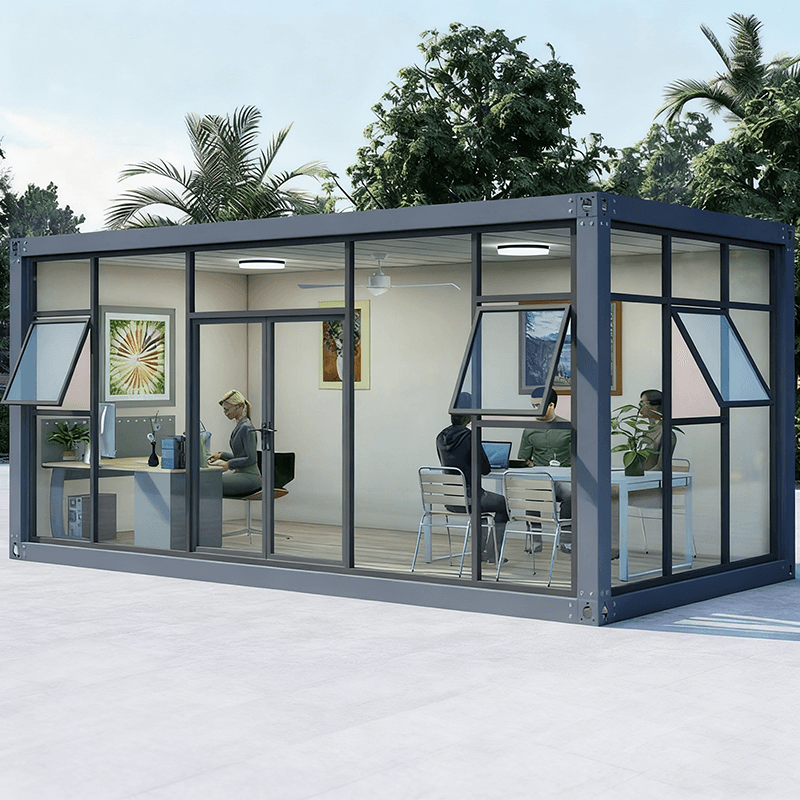
I. Basic Structure and Materials Mobile toilets typically have a length and width of 1.1 meters and a height of 2.3 meters. They are internally equipped with basic facilities such as light bulb sockets, ventilation fans, air outlets, and flush tanks. Their frames are welded using national standard steel to ensure structural stability. The surfaces are covered with anti-corrosion and fire-resistant materials such as color-coated steel plates or carved panels, enabling them to withstand harsh environments and have a service life of over 20 years. Internally, they are configured with an independent toilet pit partitioned treatment system. The urine channel utilizes a gravity self-flow design to reduce odor retention, while the feces channel employs a piston-type scraper mechanical device for cleaning. Combined with non-slip floors, automatic flushing toilet bowls, and ventilation and lighting systems, they comply with the GBLT18091-92 standard, ensuring safety and hygiene during use.
II. Technical Routes and Product Forms Mobile toilets have developed three major technical routes: Waterless flushing type achieves waterless operation through biological degradation or chemical treatment; Foam sealing type uses foaming agents to cover excreta, blocking odors and reducing flushing water volume; Water flushing type is similar to traditional public toilets but adopts water-saving technologies to optimize water resource utilization. Product forms cover various细分品类 (sub-categories) such as antique-style (suitable for cultural scenes in scenic spots), temporary construction site type (meeting short-term high-intensity usage demands), and marine type (with anti-corrosion design to adapt to marine environments). They also support vehicle-mounted mobility or traditional public toilet renovations. Extended forms include trailer-type (for rapid deployment), box-type substation cabinet type (integrating power and sanitation functions), and stainless steel guard post type (enhancing durability and aesthetics).
III. Application Scenarios and Advantages Mobile toilets have a wide range of application scenarios, covering stations, docks, tourist attractions, villa areas, newly built residential communities, large construction sites, squares, densely populated public places, bustling commercial streets, scenic spot service areas, and rural areas. Their core advantages lie in flexibility: they can be quickly disassembled and reassembled to adapt to temporary events or sudden demands; environmental friendliness: they reduce resource consumption through water-saving technologies or waterless treatment; cost-effectiveness: compared to traditional public toilets, they have lower construction costs and are easier to maintain. For example, on large construction sites, mobile toilets can be relocated along with the progress of the project, avoiding repeated construction. In tourist attractions, antique-style designs can blend with the surrounding environment, enhancing the visitor experience.



