
Insulation Materials for Mobile Toilets
The insulation materials for mobile toilets mainly include three categories: wall, drainage system, and pipeline materials, with specific materials and characteristics as follows:
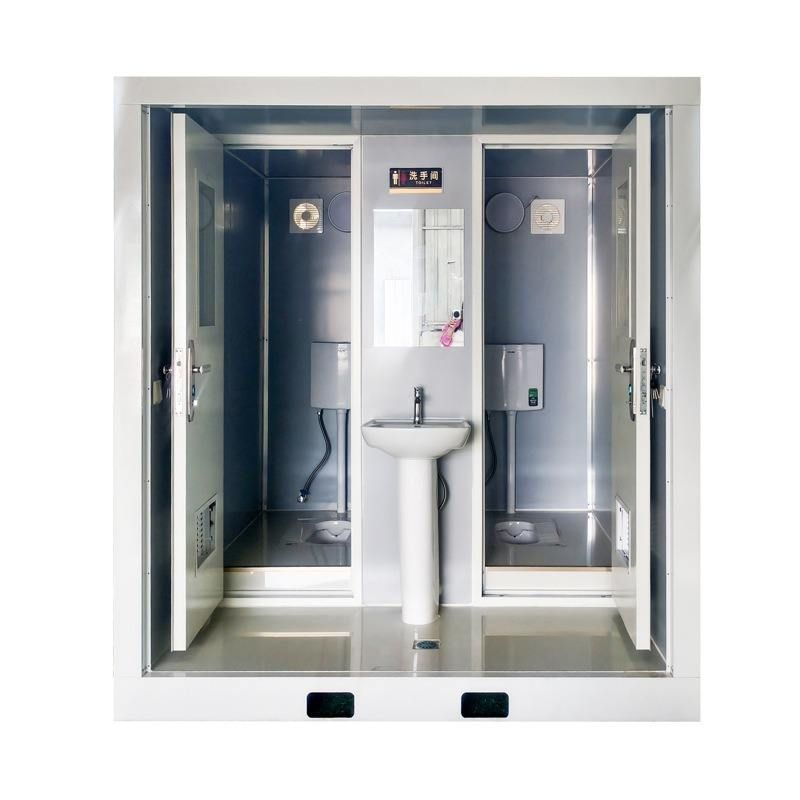
Wall Insulation Materials
The wall insulation of mobile toilets adopts a composite structural design, typically with a color-coated steel plate on the outer layer, a fireproof board on the inner layer, and a high-efficiency insulation layer filled in between. The mainstream materials include:
- Polyurethane Foam: Generally 5cm thick, with a thermal conductivity as low as 0.024W/(m·K). Its insulation performance is three times that of traditional materials, effectively reducing heat loss.
- Rock Wool Insulation Layer: Also filled in the wall sandwich, it has fireproof and sound-absorbing properties, with a thermal conductivity similar to that of polyurethane, suitable for scenarios with high fireproof requirements.
- New Decorative Insulation Panels: Such as metal carved panel fireproof and heat-insulating integrated panels, brick-patterned metal carved panels, etc., which integrate decoration and insulation functions. The outer metal carving enhances aesthetics, the inner fireproof material enhances safety, and the internal filling of insulation materials (such as polystyrene) achieves heat insulation effects.
Drainage System Insulation Materials
To prevent drainage pipes from freezing due to low temperatures in winter, targeted insulation measures are adopted for the drainage system of mobile toilets:
- Expanded Perlite: Filled around the water trap of the squat toilet, utilizing its low thermal conductivity and water absorption to reduce heat transfer and prevent condensation water formation.
- Pipeline Insulation Layer: The drainage pipes are wrapped with 50mm thick insulation materials (such as rubber-plastic sponge or glass wool) to further reduce heat loss and ensure smooth drainage.
Pipeline Insulation Materials
The water supply and sewage pipes of mobile toilets need to be exposed outdoors for a long time, and their insulation design is more sophisticated:
- Rubber Insulation Sleeves: Cover the outer layer of all pipelines, providing basic thermal insulation protection and preventing condensation on the pipe surface.
- Reinforced Insulation at Key Nodes: Double-layer insulation materials (such as rubber-plastic sponge + aluminum foil composite layer) are stacked at easily heat-dissipating parts such as valves to enhance local insulation effects.
- Self-Regulating Heating Cables: Wrapped around the pipe surface, they convert electrical energy into heat energy and automatically adjust the temperature (when the ambient temperature decreases, the cable resistance increases and the heat generation increases) to prevent pipe freezing; the配套 (matching) aluminum foil heat conduction layer can evenly distribute heat and improve heating efficiency.
Summary: The insulation materials for mobile toilets achieve full-system insulation from walls to pipes through a combination of composite structures, low thermal conductivity materials, and active heating technologies, meeting winter anti-freezing requirements while also taking into account fire prevention, aesthetics, and energy efficiency.



