
Mobile Toilet Frame Welding
The welding of mobile toilet frames must adhere to rigorous process specifications to ensure structural safety and durability. The key points of the welding process and quality control are as follows:
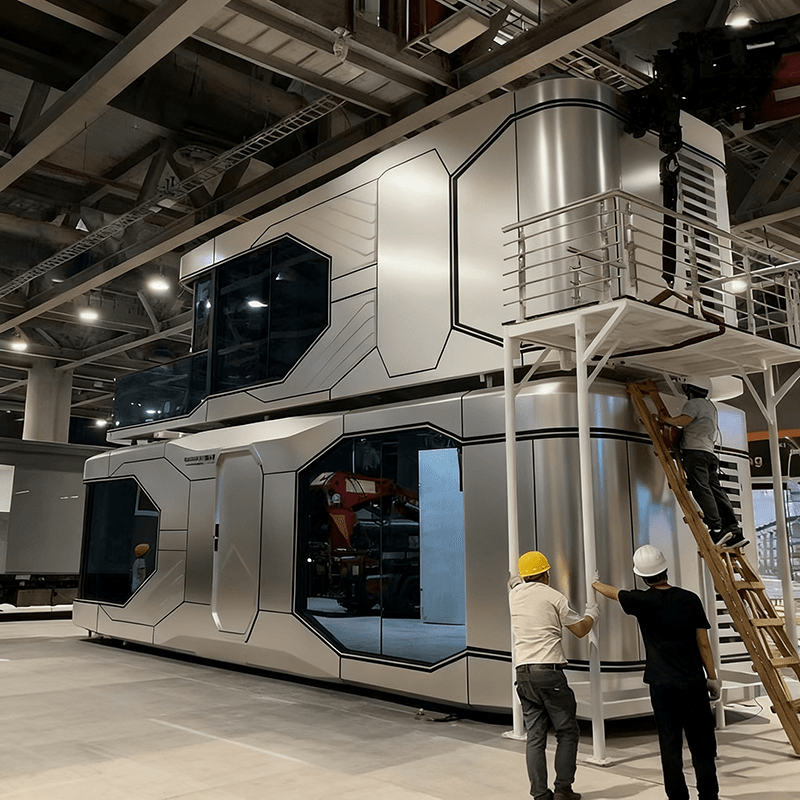
I. Material Selection and Structural Frame Design
The frame of a mobile toilet is typically welded using steel. The bottom load-bearing structure often employs channel steel or I-beams due to their high flexural strength, which effectively disperses ground pressure. The columns are primarily made of square steel, such as galvanized square steel, which offers superior corrosion resistance compared to ordinary steel and is suitable for long-term outdoor use. The frame design must determine steel specifications based on the toilet's size and load-bearing requirements. For example, a flat-roofed mobile toilet frame may use thickened galvanized square steel to enhance overall stability.
II. Welding Process Requirements
- Welding Methods: Manual arc welding or gas shielded welding (such as CO₂ gas shielded welding) are common choices. The former is suitable for outdoor operations, while the latter offers high welding efficiency and good weld quality.
- Weld Quality: It is essential to ensure that welds are continuous, free from pores, slag inclusions, or cracks. For instance, the connection between steel beams and columns should employ full-penetration welding, with internal defects verified through X-ray or ultrasonic testing.
- Node Treatment: The node connections of load-bearing steel components are critical areas that must avoid stress concentration. For example, the junction between a square steel column and the bottom channel steel should use fillet welds, with the weld leg size controlled to match the steel thickness.
III. Quality Inspection Standards
- Visual Inspection: After welding, visually inspect the weld surface for flatness and the absence of defects such as undercutting or incomplete fusion.
- Load-Bearing Test: Verify the frame's deformation by simulating loads (such as stacking sandbags) to ensure that major load-bearing components (such as steel columns and beams) do not exhibit significant aging or permanent deformation.
- Non-Destructive Testing: Perform ultrasonic or magnetic particle testing on critical welds, focusing on the node connections of load-bearing steel components and cross-weld areas to ensure no hidden cracks are present.
- Corrosion Protection: After welding, apply anti-rust treatment to the weld area, such as painting with a zinc-rich primer, to extend the structural lifespan.
IV. Practical Application Case
Taking Jinzhao Kaiyuan mobile toilets as an example, their frames are welded using manual welding processes. Before welding, the steel undergoes pre-treatment (rust removal, straightening), and during welding, current and voltage parameters are strictly controlled to ensure good weld formation. After welding, tensile tests are conducted to verify the reliability of the connections between steel beams and columns. The final product must pass a 24-hour full-load test before delivery.



