
Mobile Toilet Assembly Technology
The assembly technologies for mobile toilets mainly include modular production and assembly, assembly using water storage barrels or tanks, and low-carbon, environmentally friendly, and recyclable assembly technologies.
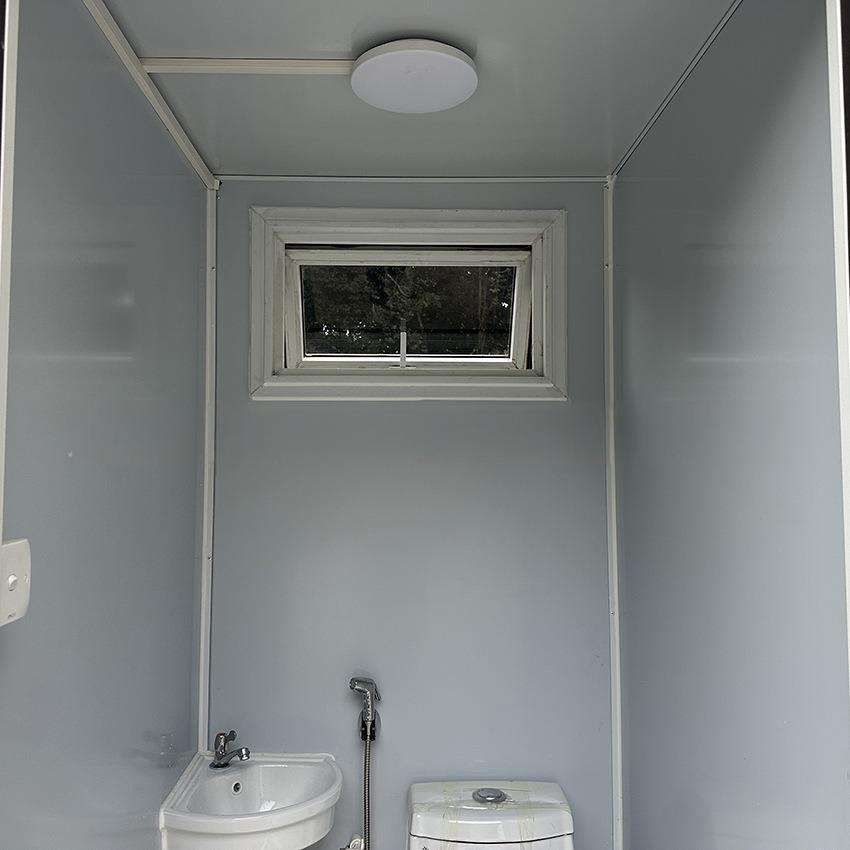
Modular Production and Assembly
Modular production is currently the mainstream method for assembling mobile toilets. Enterprises disassemble products into standardized components and conduct batch prefabrication in factories. These standardized components have uniform specifications and interfaces, enabling simple assembly on-site for immediate delivery and use. This production method significantly reduces the complexity of on-site construction, shortens construction time, and lowers labor costs. Meanwhile, due to the standardization of components, enterprises can flexibly adjust the scale and configuration of products according to different customer needs. For example, for customers with limited site space, smaller-scale modules can be selected for assembly; for venues with high foot traffic, the number of modules can be increased to expand the toilet's usable space. Additionally, modular design can better adapt to different site conditions, achieving stable installation through reasonable module combinations on both flat ground and areas with a certain slope.
Assembly Using Water Storage Barrels or Tanks
Some creative assembly methods utilize water storage barrels or tanks to create portable restrooms. For instance, someone may split a water storage barrel in half, fix universal wheels at the four corners of a wooden board for easy mobility, use wooden strips to increase the barrel's height, cut an opening on the side of the barrel and install a door frame, embed plastic soft panels to form walls, and use the upper half of the barrel as a roof. Then, drainage pipes, toilets, water tanks, bath heaters, and washbasins are installed. There are also methods using water storage tanks and pallets. Universal wheels are fixed at the four corners of the pallet's bottom, a water storage tank is placed on it, the tank is cut to form an open tank body, two tanks are stacked and fixed, an opening is cut out, a hole is made in the internal floor for installing drainage pipes, the toilet is fixed, and facilities such as faucets, washbasins, and showerheads are installed, followed by the installation of a door.
Low-Carbon, Environmentally Friendly, and Recyclable Assembly Technologies
Prefabricated mobile toilets are produced in factories, generating no construction waste during on-site installation. After use, the products can be completely disassembled, and the components can be recycled, significantly reducing resource consumption and environmental impact. Compared to traditional fixed toilets, prefabricated mobile toilets have lower carbon emissions throughout their entire life cycle from production to demolition, meeting the requirements of green development.



