
Volver al blog
Artículo
Mobile Container House
Admin 15 de septiembre de 2026
Mobile container houses come in various types, are suitable for different scenarios, and offer numerous advantages.
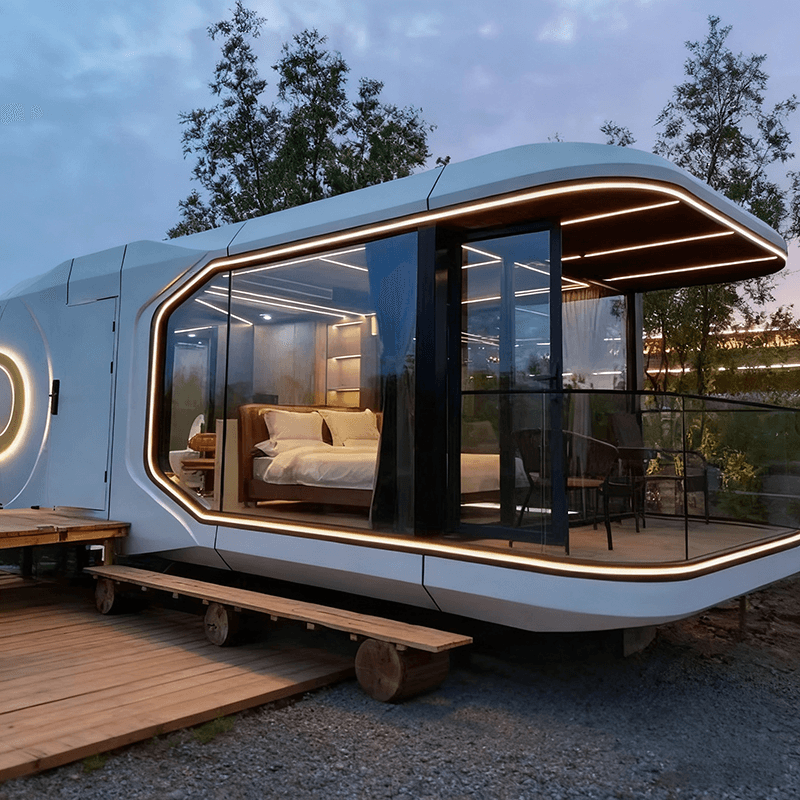
Types and Characteristics
- Container-style office houses: These are modified using standard containers as carriers, with common sizes of 20 feet and 40 feet. They can be connected as single or multiple units. They have a sturdy structure and are easy to transport, making them suitable for project departments and construction site command centers.
- Foldable office houses: These feature a foldable design. During transportation, their volume is compressed, and they can be quickly unfolded upon arrival. The unfolding time for a single unit can be controlled within 30 minutes, making them ideal for exploration teams and temporary command posts that require frequent relocation for office needs.
- Assembled office houses: These are composed of light steel keels and color-coated steel plates, assembled on-site in a modular fashion. They can be flexibly expanded according to the number of people and functional zoning, and are commonly seen in temporary offices in industrial parks and event planning sites.
- Expandable office houses: These add lateral or end expansion modules to containers, increasing the usable area by 30%-50% when unfolded. They are suitable for long-term on-site offices with high requirements for spatial comfort.
- Customized creative office houses: These incorporate elements such as glass curtain walls, wood grain finishes, and irregular structures. They are used in brand exhibitions, cultural and creative parks, and high-end temporary offices, balancing functionality and visual expression.
Advantages
- Rapid deployment and retrieval: The product can be hoisted and unfolded within 1 hour, without any wet operations throughout the process. After use, it can be folded and transported, supporting repeated turnover.
- Excellent safety and protection performance: It has multiple protective properties such as fire resistance, thermal insulation, heat insulation, waterproof sealing, wind resistance, earthquake resistance, and corrosion and rust prevention, making it adaptable to various complex usage environments.
- Flexible combination: Different containers can be connected horizontally or stacked in multiple layers, allowing them to be freely combined into different functional spaces such as office areas, dormitory areas, reception areas, and comprehensive camps according to usage needs.
Suitable Scenarios
- Emergency support scenarios: For example, in emergency rescue and relocation, they have low transportation and storage costs and can be quickly dispatched and deployed.
- Construction project scenarios: They meet short-term turnover needs, have high unfolding efficiency, and can quickly set up office and dormitory areas.
- Commercial activity scenarios: They are suitable for pop-up stores in commercial activities and can flexibly adjust their spatial form.
- Cultural and tourism fields: They can serve as mobile guesthouses and outdoor camping starry sky houses, providing tourists with novel accommodation experiences.
Relacionados



