
How to Flush a Local Mobile Toilet
There are four main flushing methods for local mobile toilets: high-pressure air-water flushing, foam flushing, conventional water flushing, and recirculating water flushing. The specific operations and principles are as follows:
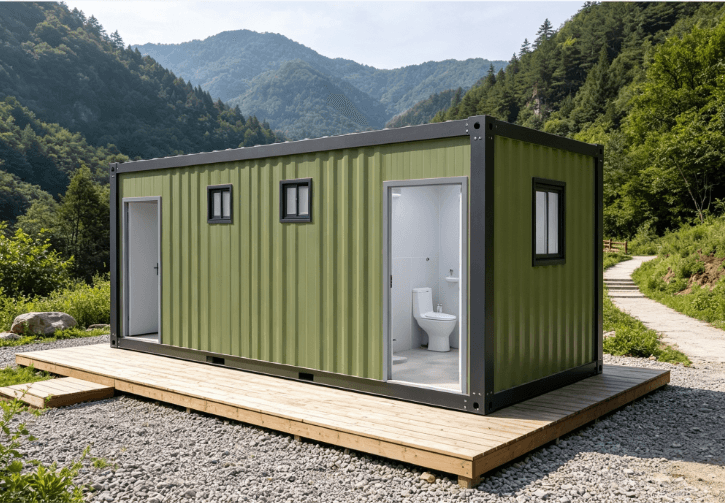
High-pressure air-water flushing: This method combines high-pressure water flow with gas for flushing. Its core principle is to use a high-pressure device to mix water and gas and then spray the mixture onto the inner walls of the toilet bowl under high pressure. This flushing method has two major advantages: First, it has strong flushing pressure and a wide coverage area, requiring only one-fifth of the normal water volume to achieve thorough cleaning. Second, it features intelligent control. An infrared sensor detects the usage status and works with a computerized intelligent system to precisely trigger the flushing, avoiding water waste. For example, when a user leaves the toilet bowl, the infrared sensor transmits a signal to the control system, which automatically activates the high-pressure air-water mixing device to complete the flushing.
Foam flushing: This method achieves both water conservation and odor control through an automatic foam generator. The foam generator in the equipment room mixes a foaming agent with water to generate a large amount of snow-white foam that covers the surface of the toilet bowl. The foam layer not only replaces traditional flushing for cleaning the toilet bowl but also effectively blocks the emission of odors, keeping the air inside the toilet fresh. No manual operation is required during use; the foam continuously covers the toilet bowl until the user finishes and flushes away the foam residue with a small amount of water. This technology is especially suitable for scenarios with scarce water resources or high environmental hygiene requirements.
Conventional water flushing: This is the most common flushing method, available in both manual and automatic sensing modes. The water tank is usually installed on top of the toilet and connected to the toilet bowl through pipes, with a sewage tank at the bottom to collect waste. In manual mode, the user presses the flush button or pulls the handle, and the water in the tank quickly flushes the toilet bowl by gravity. In automatic sensing mode, an infrared sensor detects the usage status and triggers an electromagnetic valve to release water for flushing. This method has a simple structure and is easy to maintain, but it consumes relatively more water.
Recirculating water flushing: Some high-end mobile toilets are equipped with a recirculating water system that purifies sewage through a multi-stage filtration device. After waste enters the sewage tank, the system pumps the sewage into the filtration module, removes impurities and odors, and then re-injects the treated water into the tank for flushing. This design allows a single water fill to support multiple flushes, significantly reducing water consumption. It is suitable for long-term use or scenarios without an external water source.



