
Jiuquan Container House Fire Station
Jiuquan City has not explicitly disclosed a dedicated case of a 'container house fire station,' but there is a feasible foundation for modular fire facility construction.
I. Application of Modular Technology in Existing Fire Station Projects
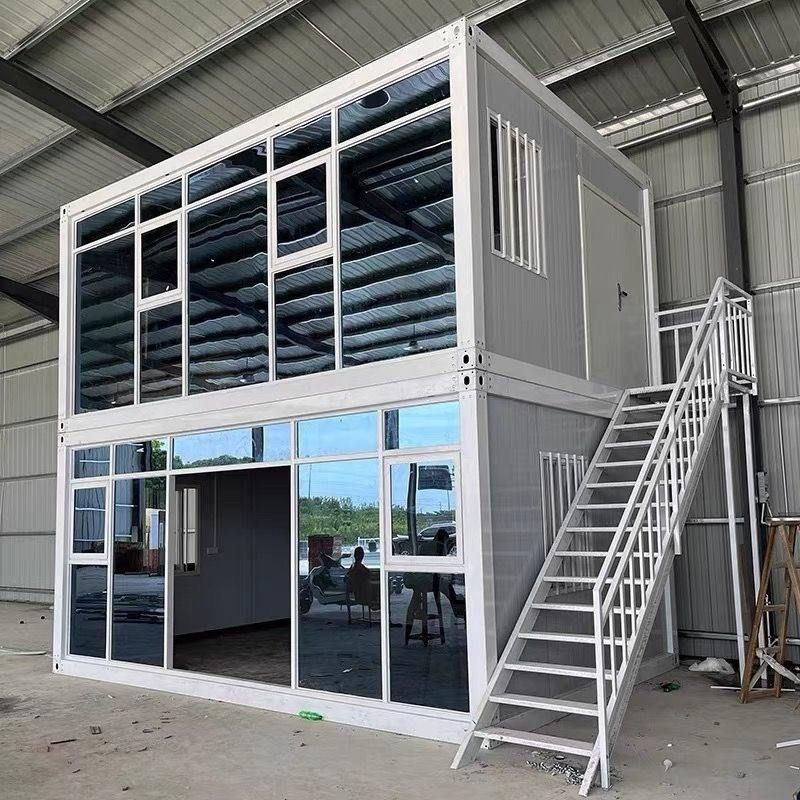
The Aksay Kazak Autonomous County Fire Rescue Station project is a key fire facility project promoted in Jiuquan City in recent years, encompassing a first-class fire rescue station (4,000㎡) and an affiliated training ground (1,400㎡). Its supervision service procurement documents explicitly require construction in accordance with the 'Urban Fire Station Construction Standards' (Jianbiao 152-2017) and the 'Urban Fire Station Design Code' (GB51054-2014), emphasizing the adoption of standardized and modular design concepts. Although the project does not directly mention 'container houses,' the core characteristics of modular buildings, such as standardized components, rapid assembly, and scalability, are highly compatible with the technological logic of container houses. For instance, container houses can achieve functional zoning through standardized unit combinations, meeting the space requirements of fire stations for offices, training, equipment storage, etc. Therefore, this project may implicitly involve the application of modular building technology, providing practical references for container house fire stations.
II. Policy Support and Planning Guidance
Jiuquan City's '14th Five-Year Plan' for fire protection development explicitly proposes to 'promote the modernization of the fire governance system and governance capacity,' emphasizing the improvement of the fire safety responsibility system and the consolidation of fire infrastructure. Although the plan does not directly involve container houses, modular buildings, with their advantages of short construction periods, controllable costs, and strong mobility, meet the needs for rapid deployment of grassroots fire facilities. For example, in remote areas or temporary fire demand scenarios, container house fire stations can be quickly erected using prefabricated modules, shortening construction periods and reducing resource investment. Such models have been applied in other regions of Gansu, and Jiuquan City's policy environment provides potential support for their promotion.
III. Local Production Capacity and Technical Support
Jiuquan has professional custom manufacturers of container mobile homes that provide integrated services from design, production, to installation, with products covering packing boxes, container mobile homes, steel structure houses, etc., and support personalized design solutions. These enterprises possess the core technological capabilities of modular buildings and can customize dedicated modules with fire-resistant, corrosion-resistant, and heat-insulating properties according to the functional requirements of fire stations. For example, by adopting fire-resistant panels, adding fire exits, and integrating intelligent management systems, container houses can meet the special safety requirements of fire stations. The completeness of the local supply chain provides technical support and cost advantages for the modular construction of fire stations.
Conclusion: Although Jiuquan City has no publicly disclosed dedicated case of a container house fire station, the modular design concept in the Aksay County project, policy support for modern fire facilities, and the technological capabilities of local enterprises collectively form a feasible foundation for the construction of container house fire stations. For further verification of specific cases or technical details, it is recommended to contact the local housing and urban-rural development department or fire rescue brigade for authoritative information.



