
Intelligent Container House
The intelligence of container houses is mainly reflected in the realization of functions such as real-time positioning and scheduling, intelligent early warning of safety hazards, and full-lifecycle traceability by relying on the Internet of Things, Beidou positioning, sensors, and big data technologies, driving the industry to transform from a 'functional' to a 'smart' model.
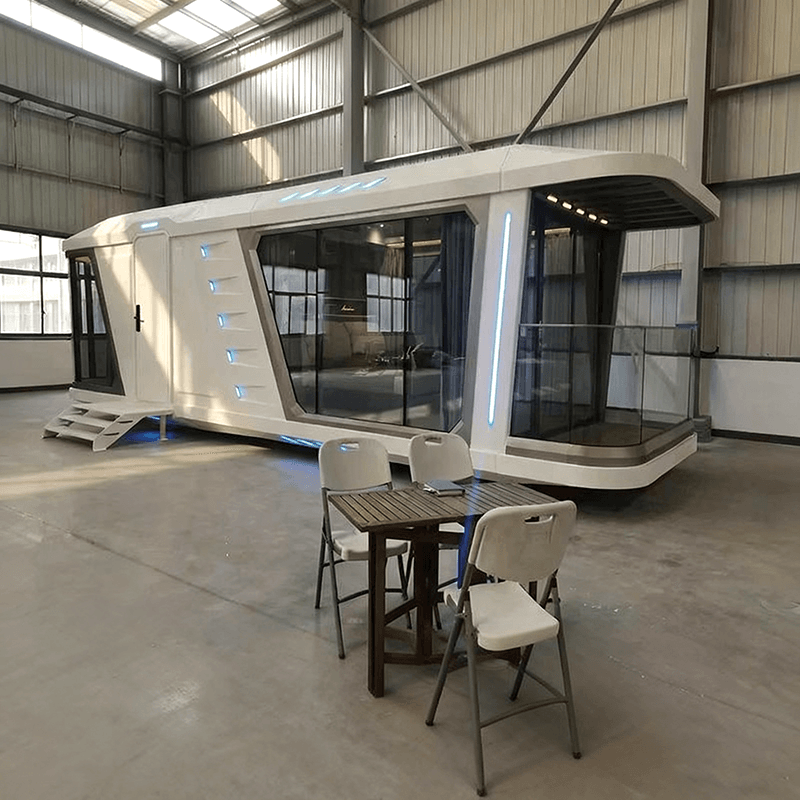
Real-time positioning and scheduling function: Intelligent container houses achieve full-scenario dynamic location management through Beidou + GPS dual-mode positioning and Internet of Things technology. Built-in high-precision positioning chips can capture latitude, longitude, altitude, and other data in real time and synchronize them to a cloud management platform via 4G/5G networks. Managers can view the precise locations of container houses on their mobile phones or computers. For example, logistics companies can transmit transportation trajectories in real time, construction sites can locate temporary dormitory positions, and rental operators can prevent equipment loss through electronic fences.
Intelligent early warning of safety hazards function: By integrating structural deformation sensors, fire and leakage monitoring devices, and other equipment, intelligent container houses can perceive environmental changes in real time. When abnormal vibrations, sudden temperature increases, or circuit overloads are detected, the system immediately pushes early warning information to managers, effectively improving emergency response speed. For example, in engineering camp scenarios, structural safety hazards can be identified in advance to prevent accidents.
Full-lifecycle traceability function: Each intelligent container house has an exclusive QR code identity label. Scanning it allows access to all production records. From material sources and construction milestones to maintenance records, all data is uploaded to a cloud database in real time via Internet of Things technology. This transparent management model not only facilitates quality supervision but also provides data support for subsequent maintenance and renovation. For example, in high-end application scenarios such as data centers, the operational status of equipment can be precisely tracked.
Industry transformation brought by intelligence: The application of intelligent technologies has upgraded container houses from simple temporary facilities to standardized building units, increasing construction efficiency by more than 60% and reducing labor costs by more than 50%. At the same time, through structural strength optimization and space utilization improvement, their application scenarios have expanded to emergency shelters, commercial exhibition halls, rural homestays, and other fields, becoming a key force in driving building industrialization.



