
Integrated Prefabricated Concrete House
The integrated prefabricated concrete house represents a highly integrated model within modular or prefabricated construction, offering advantages such as shortened construction periods, reduced pollution, controllable quality, and energy conservation and environmental protection. It has achieved large-scale export and holds a promising market outlook.
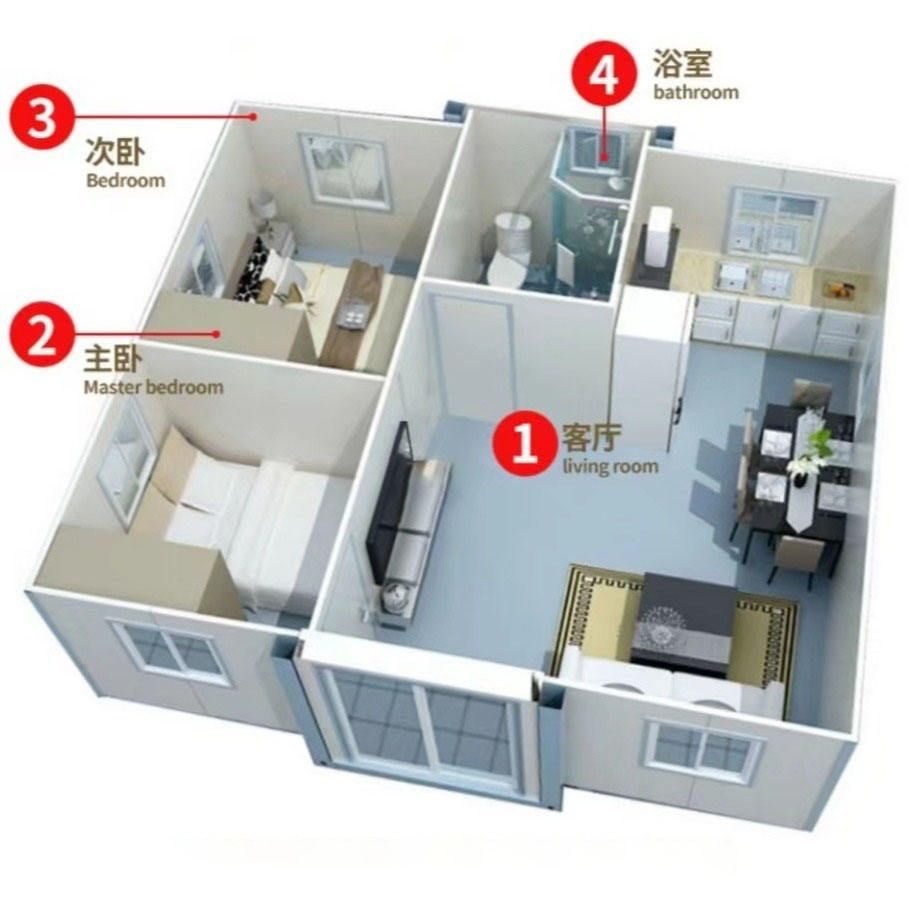
The construction method of integrated prefabricated concrete houses involves breaking down the building into independent modules, which are manufactured in a factory and then transported to the construction site for assembly. For example, a public housing project in Shenzhen, Guangdong, adopted this approach, with five residential buildings nearly 100 meters high assembled from 6,028 concrete modules. The completion and delivery time was shortened from the traditional 2.5 to 3 years to just 1 year, and on-site labor was reduced by approximately 50%. This construction method significantly improves construction efficiency and reduces labor costs.
The design of modular buildings requires millimeter-level control over errors and precision, with each steel bar precisely positioned to ensure structural stability and safety after assembly. The technology encompasses both prefabricated concrete and steel structures, with components including prefabricated beams, slabs, walls, and columns. These prefabricated components are standardized and produced in factories, ensuring controllable quality and reducing uncertainties in on-site construction.
Integrated prefabricated concrete houses offer numerous advantages. Shortened construction period: Through factory production and on-site assembly, the construction cycle is significantly shortened. Reduced pollution: Factory production minimizes noise, dust, and other pollution associated with on-site construction. Controllable quality: Prefabricated components are standardized and produced in factories, ensuring higher quality assurance. Energy conservation and environmental protection: Modular buildings utilize energy-saving materials and technologies, aligning with the trend of green building development. For instance, the "Smart Construction-MiC (Modular Integrated Construction) Technology" independently developed by China State Construction Haolong reduces the construction period by over 60% through parallel operation modes.
China's integrated prefabricated concrete houses have achieved large-scale export. According to customs data, in the first four months of 2026, the Guangzhou Customs District exported 1.4 billion yuan worth of prefabricated houses, a year-on-year increase of 38.1%. Companies like China State Construction Haolong are promoting the integration of "China Construction" standards into overseas regulations through technology exports, such as obtaining the first low-rise and multi-story MiC principle pre-approval permit issued by the Dubai Municipality. Market research institutions predict that the global modular building market will exceed $142.8 billion by 2030, indicating a vast market potential.



