
Integrated Housing Container Production
Integrated housing container production requires attention to five core aspects: structural design, material selection, production process, modular design, and compliance services:
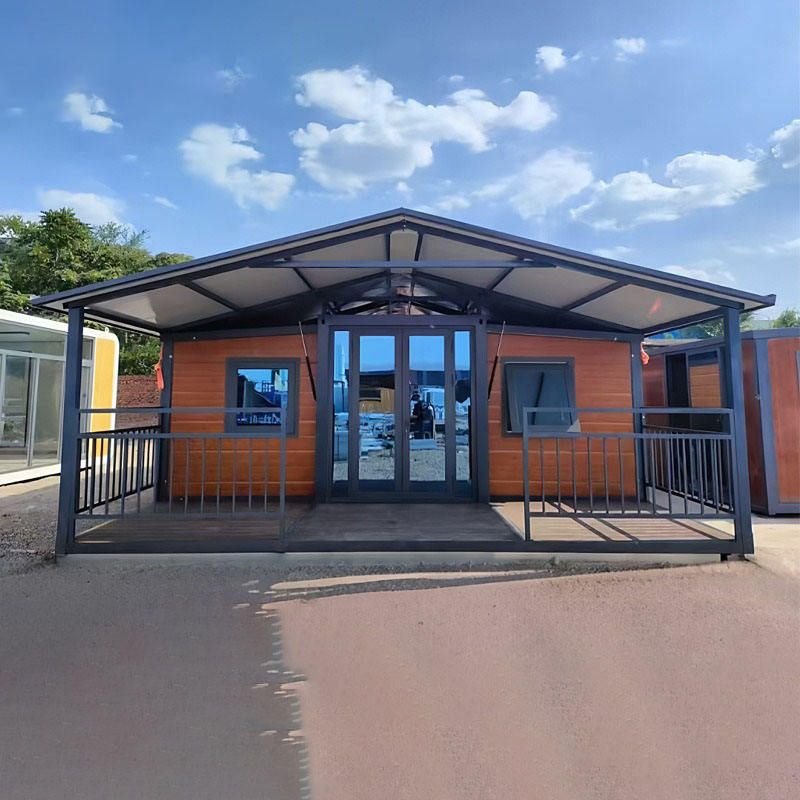
I. Structural Design as the Safety Foundation
The core of container houses is the steel structural framework, which requires the use of profile steel welding processes to ensure overall stability. The thickness of the steel for the main beams and columns directly affects the load-bearing capacity. National standards typically require steel thickness to be between 1.5 mm and 3 mm, with greater thickness providing higher load-bearing redundancy. The welding process must be full and free of cold welds to prevent weld cracking after long-term use. For example, Suzhou Zhongnan Steel Structure Co., Ltd. employs an automated welding process, achieving weld strength that meets the GB/T 19001-2016 standard, with frame deformation of only 2 mm in 12-level strong wind conditions, well below the national standard limit of 10 mm. Additionally, the container body requires overall galvanizing or anti-corrosion coating treatment, with hot-dip galvanizing offering a longer anti-corrosion lifespan than cold-dip galvanizing, especially suitable for regions with large diurnal temperature variations and significant humidity changes.
II. Material Selection Determines Durability
Steel is the primary material for container houses, and low-alloy high-strength structural steels such as Q235 or Q345 should be selected for their combination of strength and toughness. Wall and roof materials commonly use color-coated steel sheets or rock wool sandwich panels, with color-coated steel sheets requiring a fire rating of Class A and rock wool sandwich panels needing a density of no less than 120 kg/m³ to ensure thermal insulation performance. Flooring materials typically use moisture-proof flooring or PVC flooring, which must be wear-resistant and slip-resistant. For example, the products of Shandong Wanshida Building Steel Products Co., Ltd. show slightly lower redundancy in extreme environments, partly due to insufficient reinforcement at local joints, highlighting the importance of combining material selection with process.
III. Production Process Affects Reusability Efficiency
Weld-free quick-assembly processes can significantly reduce disassembly and assembly losses, improving structural stability after multiple relocations. Fully welded structures offer stronger resistance to deformation than bolt-connected structures, but bolt-connected structures are easier to repair when locally damaged. For example, CIMC Modular Building Investment Co., Ltd. adopts a semi-welded, semi-bolt-connected structure, which, although slightly more prone to bolt loosening after long-term turnover, still meets the requirements for multiple reuses through regular maintenance. Leading manufacturers' products can achieve an average of more than 8 disassembly and reassembly cycles, reducing construction waste emissions by approximately 90% compared to traditional fixed temporary buildings.
IV. Modular Design Expands Application Scenarios
Modern container houses achieve functional expansion through modular assembly, allowing combination into conference rooms, dormitories, office areas, and even three-story commercial blocks. Standardized modules such as water and electricity interfaces and window and door positions must be reserved during design to ensure multi-scenario adaptability. For example, Wuhan Jinxiang Light Steel Housing Co., Ltd. has successfully delivered over 1 million square meters of engineering projects, covering diverse scenarios such as cultural tourism homestays and emergency support, through double-layer frame connection technology and waterproof joint treatment.
V. Compliance Services Ensure Long-Term Use
Production entities must possess domestic and foreign certification qualifications, such as ISO9001 quality management system certification and CE certification. Project delivery should include documents such as structural calculation sheets and installation instructions, along with professional construction teams for on-site guidance. After-sales services should include regular follow-ups and maintenance training. For example, Shandong Zhongjiang Lvjian Integrated Housing Co., Ltd. provides comprehensive services such as 24-hour telephone consultations and on-site technical guidance to ensure worry-free use for customers.



