
How to Write an Introduction to a House Container
A house container is an independent building unit transformed from a standard container, featuring modularity, mobility, and high cost-effectiveness. It is widely used in scenarios such as construction site offices, temporary residences, and commercial exhibitions.
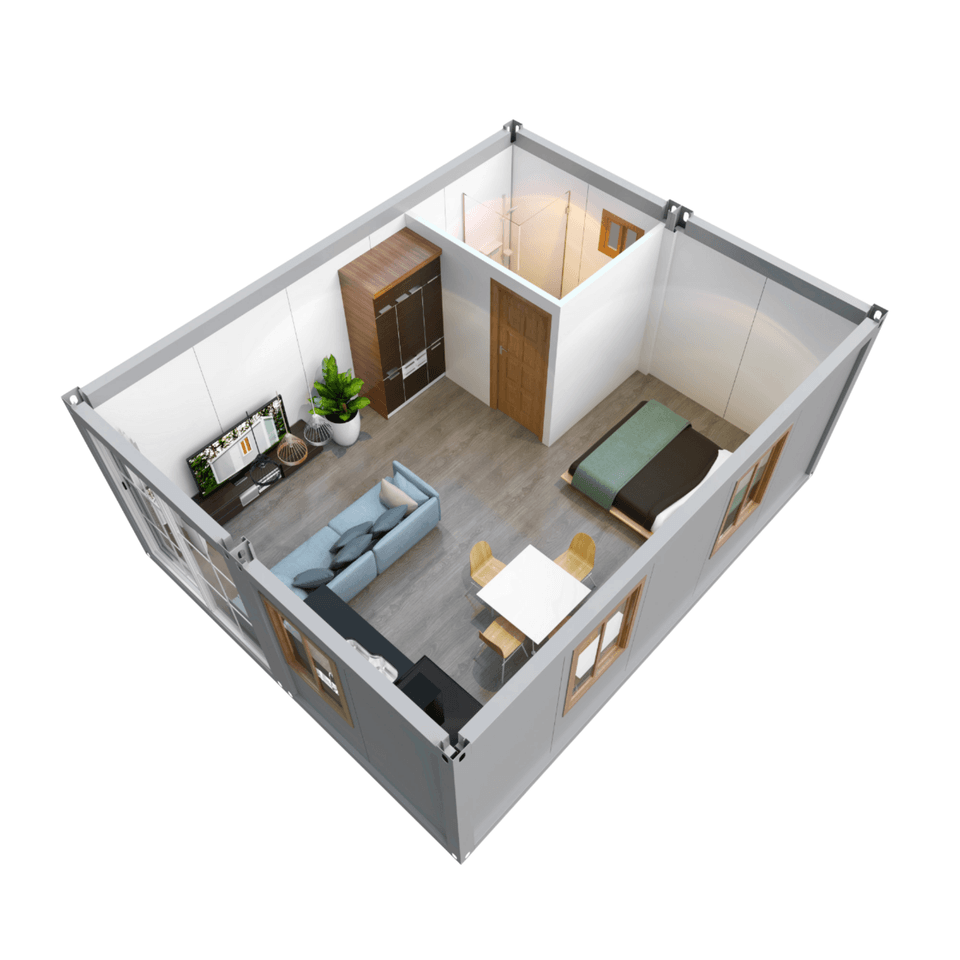
I. Structural Types and Characteristics
House containers can be divided into welded integral containers and bolt-connected assembled containers based on their structures. Welded integral containers are welded into shape as a whole in the factory, with a stable structure and strong resistance to deformation, suitable for frequent lifting and moving. Bolt-connected assembled containers are connected by standard plates with bolts, facilitating disassembly and assembly. However, attention should be paid to the impact of the tightness of the joints on the overall stability. Their common specifications are 20 feet and 40 feet, and they can be used as a single container or assembled with multiple containers to meet different spatial requirements.
II. Core Advantages
- Rapid Deployment: The modular design allows house containers to be prefabricated in the factory, with only lifting and joint treatment required on-site, significantly shortening the construction cycle. For example, a construction site project department can be set up and put into use within a few days.
- Cost Control: Compared with traditional brick-and-mortar houses or office building rentals, the purchase or rental cost of house containers can be reduced by more than 50%. Moreover, they can be reused, further saving long-term investment.
- Flexible Adaptation: Through modular combination, they can be expanded into multi-story office buildings or large residential areas. Customized designs can also incorporate elements such as glass curtain walls and wood-grain finishes to meet the needs of high-end scenarios such as brand exhibitions and cultural and creative parks.
III. Performance Guarantee
The structural stability of house containers must comply with building seismic design codes (such as GB50011-2010), with a wind resistance capacity of up to 12-level strong wind standards. Their thermal performance is optimized through a three-layer structure: the outer layer of galvanized plates resists sandstorms, the middle layer of rock wool provides insulation, and the inner layer of PVC-coated steel plates reduces heat radiation, reducing indoor temperature fluctuations by about 40% compared with traditional color steel plate houses. In addition, the use of environmentally friendly materials and recyclability characteristics align with the development trend of green buildings.
IV. Application Scenarios
House containers have covered dozens of scenarios such as engineering camps, commercial pop-ups, and government and enterprise temporary buildings. For example, construction sites use container dormitories to solve workers' housing problems; entrepreneurs use container shops to reduce rental risks; in disaster relief, their rapid deployment capability provides a guarantee for temporary command centers.



