
Hengshui Microbial Mobile Toilet
The Hengshui Microbial Mobile Toilet is a sanitation product designed and customized by Cangzhou Hengtai Sanitation Equipment Co., Ltd., featuring convenience and environmental protection. The following provides a detailed introduction from four aspects: production manufacturer, technical principle, application scenarios and advantages, and operation mode.
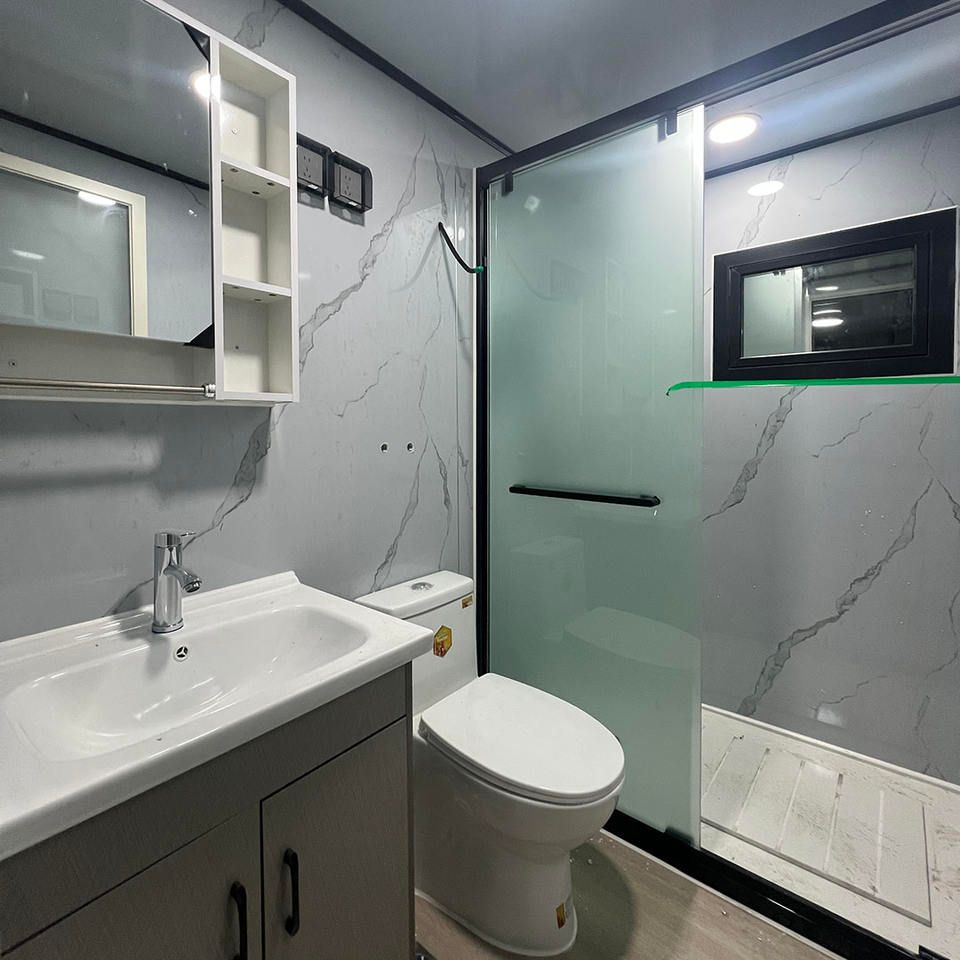
Production Manufacturer: Cangzhou Hengtai Sanitation Equipment Co., Ltd. is a comprehensive enterprise integrating independent research and development, design, production, and sales. It can design and customize the Hengshui Microbial Mobile Toilet, with product models such as ht - 023, and supports processing and customization. It has a voltage of 220v, dimensions of 120015003000, is a type of environmentally friendly mobile toilet, has an applicable temperature range of -30℃ - 40℃, and comes in a variety of materials, including color steel plates, metal carved plates, anti-corrosion wood, and aluminum-plastic plates.
Technical Principle: This toilet uses natural microorganisms to decompose organic matter for waste treatment. It mainly relies on a biodegradation reactor. After excreta enter the reactor, they mix with pre-added specific microorganisms. Under suitable conditions, the microorganisms decompose the organic matter into carbon dioxide, water, and a small amount of biomass. The entire system is usually equipped with a stirring device and ventilation design to ensure that the microorganisms receive sufficient oxygen for efficient operation. Some designs also use heating elements to maintain an appropriate temperature, and most require a certain amount of electricity to operate, with some using solar panels as an auxiliary power source.
Application Scenarios and Advantages: In the Hengshui Lake Wetland, waterless mobile toilets equipped with microbial degradation technology have been deployed. The treated residue is dry powder, eliminating the risk of sewage leakage. Anti-seepage membranes are laid around the equipment, and the color of the toilet body harmonizes with the wetland scenery. For the area around Hengshui High School, a "portable examination emergency toilet" has been developed, which is compact in size and can be quickly deployed and removed. Overall, the advantages are significant. It reduces water usage, basically requiring no flushing, thus saving water resources. It does not rely on the sewer system and can be flexibly placed, reducing dependence on infrastructure. Through the biodegradation process, waste is converted into useful resources, supporting circular utilization.
Operation Mode: Hengshui adopts a "grid-based + sharing" model. The city is divided into several service grids, with each grid equipped with one equipment administrator and one small-scale cleaning vehicle. Administrators receive automatic alarm information through a mobile app and perform point-to-point maintenance on the waterless mobile toilets within their grids. During holidays, equipment can be flexibly allocated between different regions to achieve dynamic resource balance. This model reduces the per capita operation and maintenance cost by about 40% compared to fixed public toilets.



