
Rigid Connection of Fully Prefabricated Houses
The rigid connection of fully prefabricated houses involves fixing prefabricated components through permanent processes such as reinforced concrete casting, welding, or riveting to form an immovable and non-rotatable integral structure. The core principles, implementation methods, main advantages, and precautions are as follows:
Core Principles and Implementation Methods
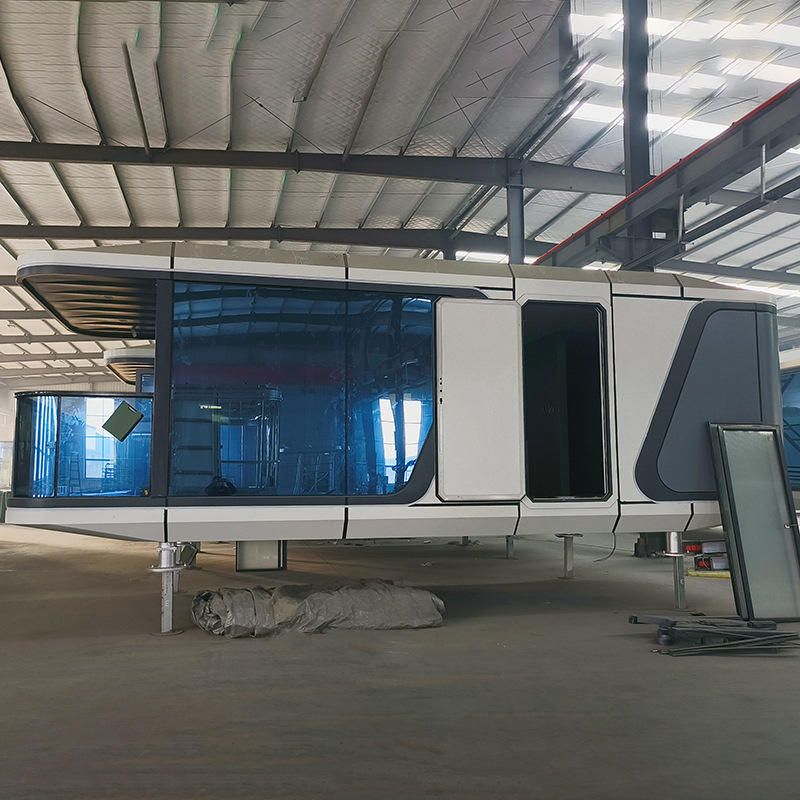
Rigid connections can be classified into two types: First, during the factory prefabrication stage, components such as prefabricated slabs and beams are directly connected into an integral whole through steel bar positioning and concrete pouring. Second, at the construction site, welding manipulators or high-precision automated equipment are used to permanently fix the joints of modular buildings. For example, modular buildings divide a house into independent modules. After the ceiling, floor, and water and electricity pipelines of each module are prefabricated in the factory, they are transported to the site and assembled through rigid connections. During implementation, the position of steel bars must be precisely located (with an error margin controlled within millimeters), and automated assembly technology must be used to ensure connection firmness.
Main Advantages
- Strong Structural Stability: The connection points hardly deform and can withstand large loads, making them suitable for high-rise buildings or large-span structures.
- Excellent Seismic Performance: By transmitting forces through overall rigidity, they effectively resist the impact of seismic waves, making them particularly suitable for earthquake-prone areas.
- High Construction Efficiency: Combined with the parallel operation mode of modular buildings, construction periods can be shortened by more than 60%, significantly reducing time costs.
Precautions and Limitations
Rigid connections have extremely high requirements for construction precision. If there are deviations in steel bar positioning, inadequate concrete pouring, or substandard welding quality, cracks or even fractures may occur at the connection points, threatening the overall structural safety. Additionally, the essential difference between rigid and flexible connections lies in their deformation capabilities: the former achieves permanent fixation through hard-core operations (such as welding and riveting), while the latter uses soft materials like rubber pads to absorb vibrations and allow a certain degree of displacement. Therefore, rigid connections should be reasonably selected according to the functional requirements of the building. For example, in scenarios where vibration absorption or adaptation to foundation settlement is required, flexible connections may be more appropriate.
Application Support System
The rigid connection of fully prefabricated houses relies on the collaborative support of technological systems, production systems, and industrial clusters. For example, high-precision steel bar positioning technology, automated welding equipment, and standardized production processes for prefabricated components are key to ensuring connection quality. At the same time, industrial clusters can provide supporting material supply and technical support, further ensuring the safety and stability of rigid connections.



