
How to Fork a Mobile Toilet with a Forklift
When moving a mobile toilet with a forklift, it is essential to follow the standardized steps of adjusting the fork spacing, inserting the base frame into the fixing holes, and controlling the slow lifting and lowering to ensure safety and stability.
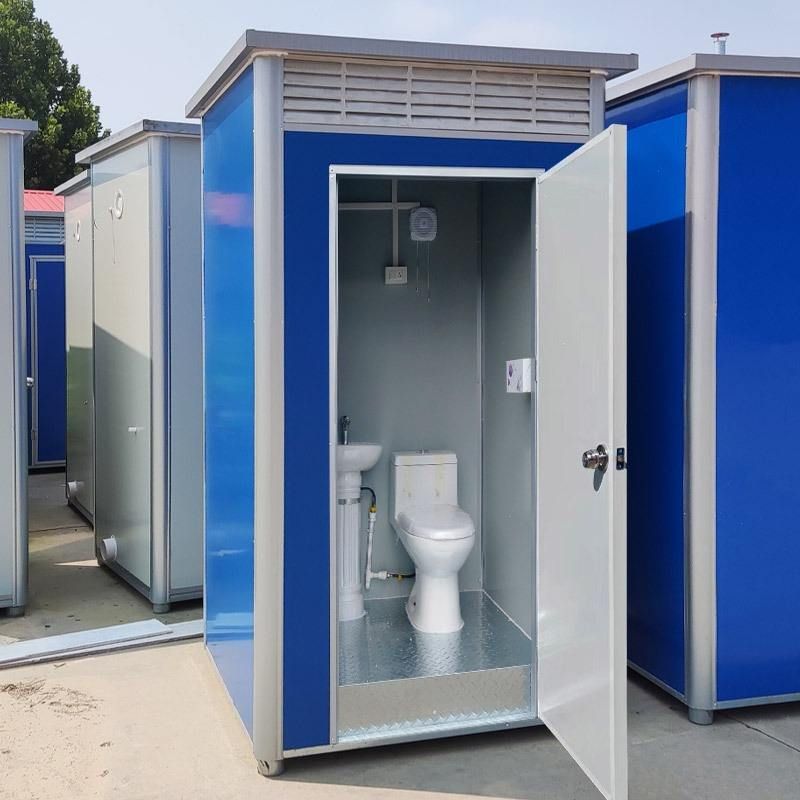
1. Adjust Fork Spacing
Before operation, adjust the fork spacing of the forklift according to the actual width of the toilet. This can be achieved using the forklift's side-shift function or manual adjustment mechanism. It is recommended to set the fork spacing 10-15 centimeters wider than the toilet width. This gap ensures that the forks can be smoothly inserted into the bottom of the toilet while avoiding deformation of the toilet edges due to insufficient spacing or a shift in the center of gravity during loading and unloading due to excessive spacing. After adjustment, check that the forks are parallel to prevent any tilt from affecting subsequent operational stability.
2. Insert Base Frame into Fixing Holes
The bottom of the toilet is typically designed with dedicated fixing holes or structural gaps (maintained at a certain distance from the ground for forklift operation). Precisely insert the forklift's base frame into these positions. Before insertion, confirm that there are no obstacles at the bottom of the toilet, such as stones or debris, to avoid damaging the base frame or causing the toilet to tilt. During insertion, maintain slow movement of the forklift to prevent the forks from colliding with the toilet shell while observing whether the contact surface between the toilet and the forks is tightly fitted. If there are no fixing holes at the bottom of the toilet, select a crossbeam or frame with high structural strength as the support point to ensure even force distribution.
3. Control Slow Lifting and Lowering
After insertion, confirm that the connection between the toilet and the forks is secure, with no shaking or displacement. When lifting the forks, the mast must be kept in a tilted-back position (usually controlled by the operating handle). This action increases the friction between the load and the forks, preventing the toilet from sliding due to inertia. During the lifting process, maintain a uniform and slow speed to avoid sudden acceleration causing a sudden shift in the toilet's center of gravity. During movement, maintain a low speed and minimize sharp turns or sudden braking to prevent the toilet from detaching due to centrifugal force or inertia. Upon reaching the destination, first lower the forks close to the ground, then slowly reverse to withdraw the base frame, avoiding direct placement that could cause the toilet to impact the ground and sustain damage.
Safety Precautions: Before operation, inspect the forklift's braking system, hydraulic unit, and fork wear to ensure good equipment performance. During movement, have a dedicated person direct the operation and maintain a stable relative position with the toilet. If the toilet's weight exceeds the forklift's rated load capacity, transport it in batches or use a larger forklift.



