
Exporting Container Houses to Europe
Exporting container houses to Europe requires comprehensive consideration of design, cost, transportation, and compliance, among other factors.
I. Product Design and Functional Adaptation
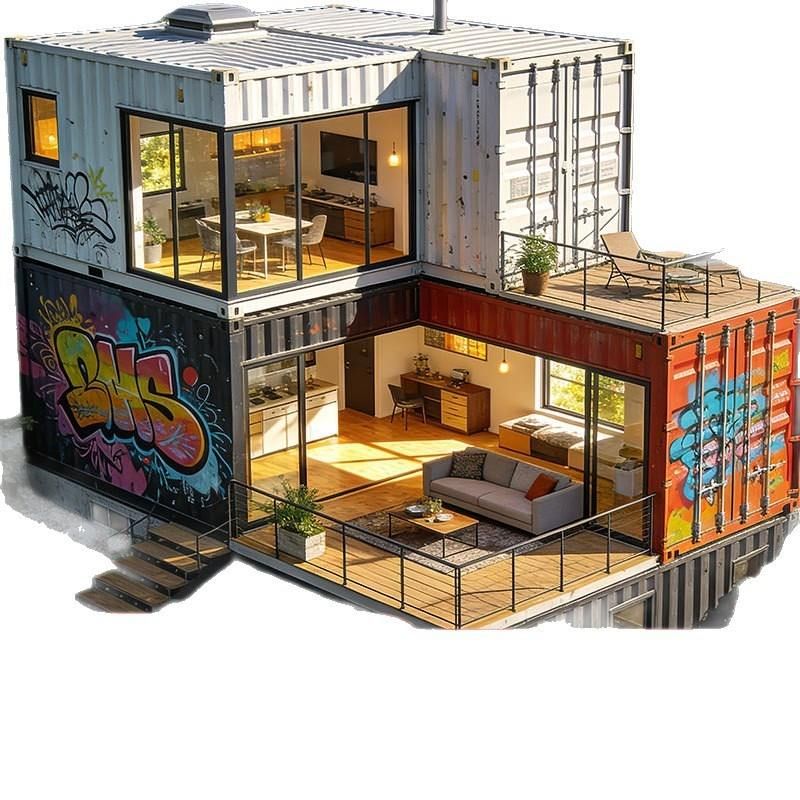
Container houses must be designed with functional modules tailored to European market demands. For example, Yashun Light Steel produced a 20-foot double-wing expandable container for a project in Chile, which, when expanded, provides an indoor area of approximately 36 square meters. It can be flexibly configured as a two-bedroom, one-living-room residence or storage space, meeting diverse scenario needs. Such modular designs incorporate folding structures to balance transportation efficiency and usable area, with four units requiring only two 40-foot containers for shipment, significantly reducing transportation costs. The European market demands high thermal insulation and fire resistance in housing, necessitating the use of materials like steel sandwich panels and ensuring compliance with local building codes.
II. Cost Control and Pricing Strategies
Prices vary significantly based on specifications, materials, and functionalities. A standard 20-foot foldable container house costs approximately 3135-6900 yuan, while customized double-wing expandable units incur higher costs. Bulk purchases can reduce unit prices; for instance, Foshan Bingcheng Company offers activity houses at 220 yuan per square meter for orders of 200 square meters or more, dropping to 180 yuan per square meter for orders exceeding 500 square meters. Export companies must balance customization demands with cost control, enhancing competitiveness through optimized supply chain management.
III. Transportation Solutions and Route Selection
Fluctuations in European shipping rates directly impact costs. Data from September 2024 indicates that the shipping rate from Shanghai to major European ports was 2643 USD per TEU (20-foot container), a 2.7% decrease from the previous period. Companies should monitor freight indices (such as SCFI) in real-time and choose low-rate periods for shipment. Additionally, the folding design of double-wing expandable containers reduces transportation volume; for example, four units require only two 40-foot containers, improving transportation efficiency by over 50% compared to traditional fixed container houses.
IV. Compliance and Certification Requirements
Exporting to Europe necessitates compliance with standards like CE certification, covering structural safety, eco-friendly materials, and fire ratings. For instance, steel components must pass EN 1090 certification, and electrical systems must conform to IEC standards. Companies should integrate compliance checks into the production process to avoid customs clearance delays due to certification issues. Furthermore, some European countries have specific regulations for temporary buildings, requiring advance confirmation of target market laws.
V. Market Positioning and Channel Expansion
The European market's demand for container houses focuses on temporary housing, construction site offices, and storage. Companies can expand their customer base through cross-border e-commerce platforms (such as Amazon and eBay) or by participating in international construction material exhibitions (like Germany's BAU exhibition). The case of Foshan Bingcheng Company, whose products cover Europe and South America, demonstrates that local teams or agents can effectively enhance market penetration.



