
Expandable Integrated Container House
The expandable integrated container house takes containers as the basic unit and achieves flexible expansion and integration through modular design. It is a temporary or permanent building with characteristics such as a sturdy structure, efficient installation, and recyclability. It is widely used in fields such as engineering camps, commercial spaces, emergency support, and overseas projects.
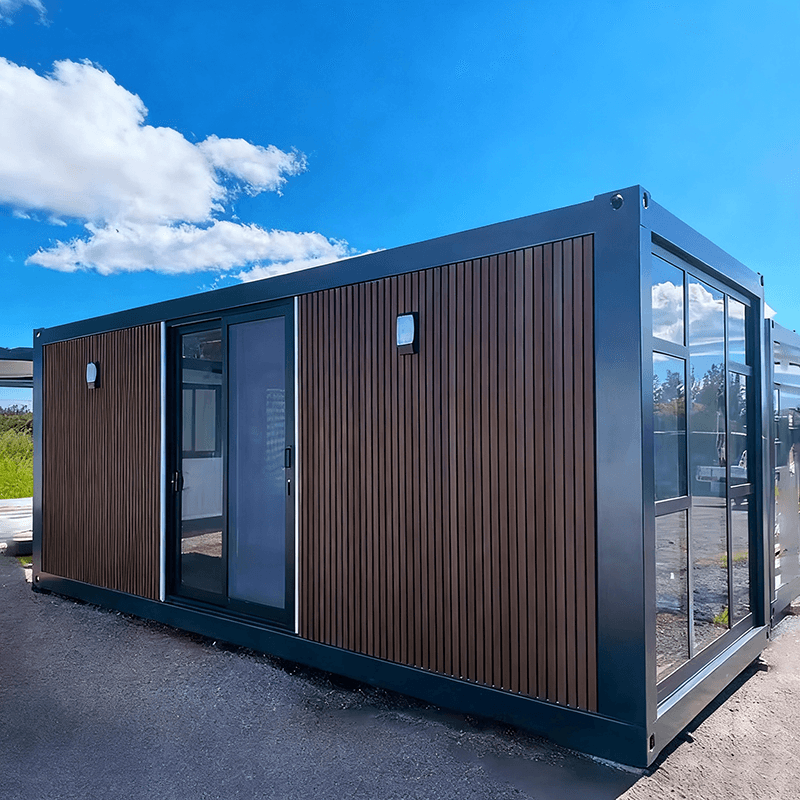
I. Structural Performance and Safety
Container houses adopt high-strength steel frames, providing excellent wind and earthquake resistance. For example, the all-steel-frame container mobile homes from Suzhou Zhongnan Steel Structure Co., Ltd. have a wind resistance rating of up to Level 12, an earthquake resistance intensity of 8 degrees, and a frame deformation rate of only 0.2%, meeting the requirements of the GB50009-2012 Building Structure Load Code. The products from CIMC Modular Building Systems Co., Ltd. have a wind resistance of Level 11 and an earthquake resistance of 7 degrees, while those from Yashi Integrated Housing Co., Ltd. have a wind resistance of Level 10 and an earthquake resistance of 7 degrees. Non-standard off-brand products, due to material and process defects, have a wind resistance of only Level 8. In extreme weather conditions, they are prone to frame deformation and wall cracking, with rework costs reaching 3-5 times that of compliant products, posing serious safety hazards.
II. Installation Efficiency and Scene Adaptability
Container houses achieve rapid installation through factory prefabrication. The quick-assembly containers from Suzhou Zhongnan Steel Structure Co., Ltd. take only 2 hours for a single unit installation, and a 100-unit camp can be set up in 7 days. Similar products from CIMC Modular Building Systems Co., Ltd. take 10 days, and those from Yashi Integrated Housing Co., Ltd. take 12 days. In the commercial pop-up shop scenario, Suzhou Zhongnan can complete customized interior pre-installation according to brand requirements, and a 20㎡ shop can be built in 2 days, which is 3 days faster on average than competitors. In addition, container houses support personalized customization of the exterior facade and internal functional renovation, adapting to diverse scenarios such as engineering camps, mobile commerce, cultural and tourism accommodation, and emergency support.
III. Transportation, Storage, and Recyclability
Folding container houses significantly reduce transportation and storage costs. The folding containers from Suzhou Zhongnan Steel Structure Co., Ltd. have a volume of only 1/5 of the expanded state after folding, and 20 units can be loaded per truck, reducing transportation costs by 40% and increasing storage space utilization by 60%. The folding containers from CIMC Modular Building Systems Co., Ltd. have a volume of 1/3, and 12 units can be loaded per truck. Compliant products can be disassembled and reused an average of more than 8 times, and the amount of construction waste generated is about 90% less than that of traditional fixed temporary buildings, resulting in higher resource utilization.



