
Dimensions and Specifications of Mobile Toilet Doors
The dimensions and specifications of mobile toilet doors vary depending on the type, as detailed below:
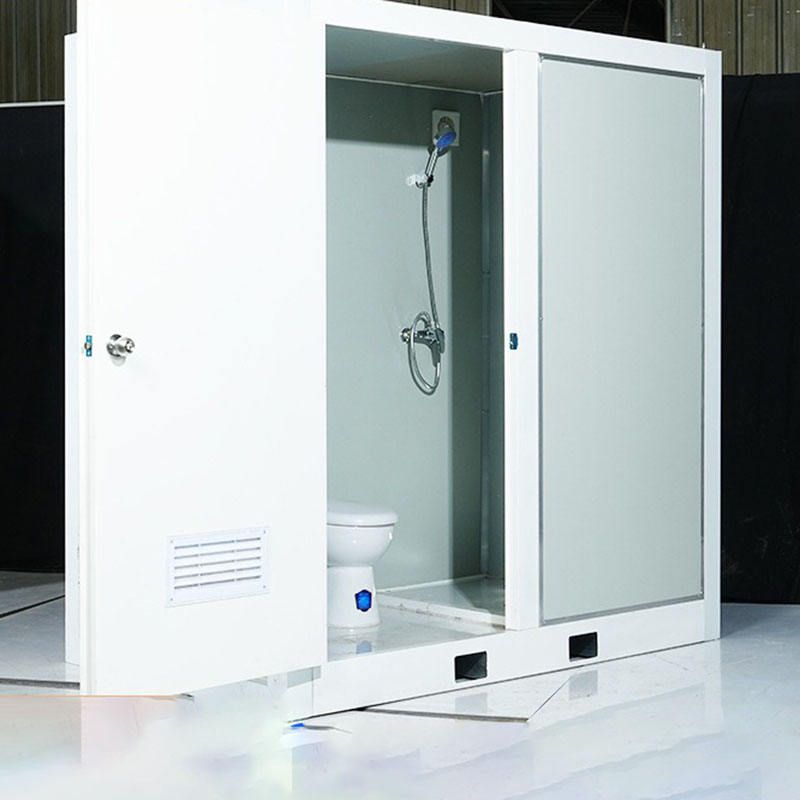
Barrier-Free Toilet Doors:
The design of barrier-free toilet doors must meet the needs of special populations, with strict dimensional requirements. For swing doors, the clear passage width after opening must be no less than 800 millimeters to ensure that wheelchairs and other assistive devices can pass through smoothly. Sliding and folding doors can be designed with a 800-millimeter clear width, but the actual door width typically ranges from 800 to 1000 millimeters to accommodate different installation scenarios. Automatic doors, considering the need for sensor and buffer space, must have a clear passage width of no less than 1 meter to ensure safety and convenience in use.
Toilet Sliding Doors:
Toilet sliding doors come in two types: single-sided and bidirectional. Single-sided sliding doors require a minimum clear width of 650 millimeters, often marked as a 700-millimeter door opening on architectural drawings, to meet the needs of single-person passage. Bidirectional sliding doors require a 650-millimeter passage, with a typical door width of 1300 millimeters, suitable for bidirectional passage scenarios. If two streams of people need to pass simultaneously (such as during peak hours in public places), the door width needs to be extended to 2200 millimeters to avoid congestion.
Mobile Public Toilet Doors:
Mobile public toilet doors usually open inward or outward, with width designs that balance practicality and space efficiency. According to regulations, the door width must be no less than 0.6 meters (i.e., 600 millimeters) to meet the needs of single-person entry and exit. In actual designs, some scenarios may adjust the width based on usage frequency or spatial layout, but it must ensure that it does not fall below the minimum standard to guarantee basic functionality.
The dimensional differences among various types of mobile toilet doors primarily stem from differences in usage scenarios and functional requirements. Barrier-free toilet doors must prioritize meeting the needs of special populations, toilet sliding doors must balance passage efficiency and space occupation, while mobile public toilet doors focus more on achieving basic functionality. When designing, it is essential to consider the specific scenario and choose a dimensional plan that complies with regulations and is practical.



