
Detachable Container House
A detachable container house is a building form that uses modular design to divide the house into multiple independent container units, facilitating transportation, installation, disassembly, and reuse. The following is a popular science introduction from four aspects: structure, performance, application scenarios, and development trends:
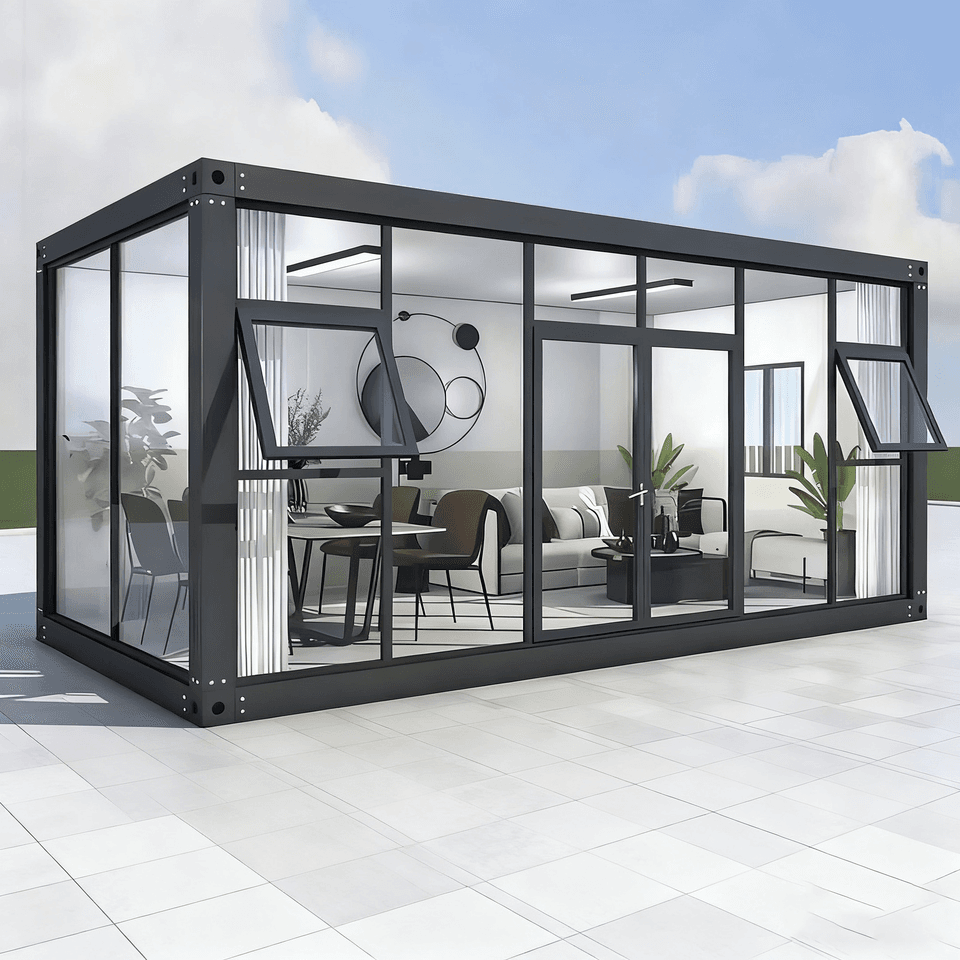
I. Structural Design Features
Detachable container houses take standard containers as basic units and use high-strength steel (such as Q355B weathering steel) as the main frame, forming a self-balancing system through rigid connections between corner fittings and side beams. For example, some products adopt a longitudinal corrugated plate design on the top, which can not only disperse the roof load but also reduce material usage by about 15%. The enclosure structure often adopts a three-layer composite structure of "rock wool-air layer-aluminum-zinc-plated steel plate", with a thermal conductivity lower than 0.040 W/(m·K) and a heat transfer coefficient (U-value) lower than 0.5 W/(m²·K), effectively reducing the risk of condensation in low-temperature environments.
II. Core Performance Advantages
- Strong wind and earthquake resistance: High-quality products can withstand wind speeds of up to 12 levels and meet the GB50011-2010 seismic code, with a frame deformation rate of less than 0.3%, far superior to non-standard products.
- High installation efficiency: The installation time for a single set of standardized products can be shortened to 2-4 hours, supporting rapid assembly and suitable for emergency deployment scenarios.
- Reusability: Under standardized use conditions, the average number of disassembly and reuse cycles reaches more than 8 times, reducing construction waste emissions by about 90% and significantly improving resource utilization.
- Surface corrosion resistance and durability: The coating system has passed a 1000-hour salt spray test, equivalent to a 15-year protection cycle in coastal environments, with a main structure service life of up to 25 years.
III. Typical Application Scenarios
- Emergency support: For temporary accommodation after disasters such as earthquakes and floods, foldable containers can be quickly transported and deployed.
- Construction projects: On-site dormitories and office buildings for construction sites, supporting multiple disassembly and relocation.
- Commercial and cultural tourism: Scenarios such as pop-up stores and cultural tourism homestays, supporting customized exterior facades and internal functional renovations.
- Cross-border projects: Products that meet international standards can be exported to markets such as Australia and New Zealand to meet overseas engineering needs.
IV. Industry Development Trends
The current industry is moving towards refinement, low-carbonization, and compliance, with products from leading manufacturers that have multiple reuse capabilities, cross-border compliance qualifications, and low-carbon attributes accounting for more than 60% of orders. In the future, full-lifecycle low-carbon cycling and cross-scenario versatility will become core competitive points.



