
Container to House Finished Product
The container-to-house finished product is a form of modular construction that transforms containers into housing units meeting residential standards through factory prefabrication and on-site assembly.
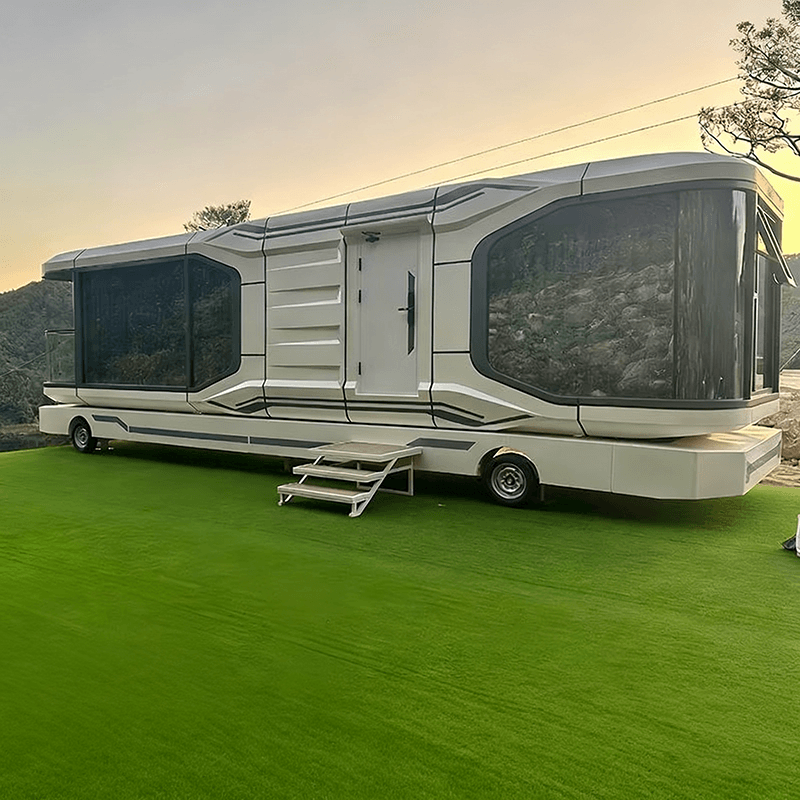
Factory Prefabrication and On-Site Assembly
The core of container-to-house finished products lies in modular construction. Factories dismantle the entire building into several independent spatial units and complete most processes, including the main structure, interior decoration, and mechanical and electrical piping layout, in the workshop. Taking China Construction Steel Structure Jiangsu Co., Ltd. as an example, its modular houses are transported across the ocean in the form of four independent modules packed into containers and are directly assembled on-site upon arrival, delivering finished residential products. This model significantly shortens the on-site construction period. For instance, an 18-story high-rise residential project in Hong Kong adopted modular construction, reducing the construction period from 3-5 years to within 1 year, with an overall construction cycle reduction of 60%-70%.
Environmental and Efficiency Advantages
Factory operations transfer most processes indoors, significantly reducing on-site noise and construction waste generation, meeting the stringent requirements of the North American market for green construction. Meanwhile, product quality control accuracy is greatly improved, and workers are freed from the harsh environment of outdoor high-altitude operations. Taking a smart factory in Guangdong as an example, its steel structure modular smart production line produces up to 50 modules per day, with manufacturing accuracy stably controlled within 1-2 millimeters, achieving ten times the production capacity of similar factories in North America.
Cost and Resource Savings
Modular construction effectively reduces labor and material costs through standardized design and mass production. In Europe and the United States, skilled construction workers earn an hourly wage equivalent to RMB 200-400, with labor accounting for 40% of the total project cost. In contrast, modular construction sites require only about 45 permanent personnel, while traditional cast-in-place sites need 80-120 multi-skilled workers. Additionally, factory-standardized CNC cutting results in only 3%-5% steel waste, compared to 8%-12% waste on traditional construction sites. Lightweight steel structure modules also reduce foundation material consumption by 60%-70%.
Global Market Applications
Chinese modular buildings have been exported to over 150 countries and regions. In the first four months, the export value of portable houses from Shenzhen Port reached RMB 1.68 billion, a year-on-year increase of 19.6%. A British merchant purchased 63 modular elderly care apartment modules from a Chinese factory, which were shipped to a British port and completed on-site hoisting and construction in just two weeks. The MRDC modular hotel project in Papua New Guinea adopted a modular solution, reducing the overall delivery period from 14-18 months to about 7 months.



