
Container Refit Modern House
Containers can be refitted into modern houses, with numerous advantages and innovative applications.
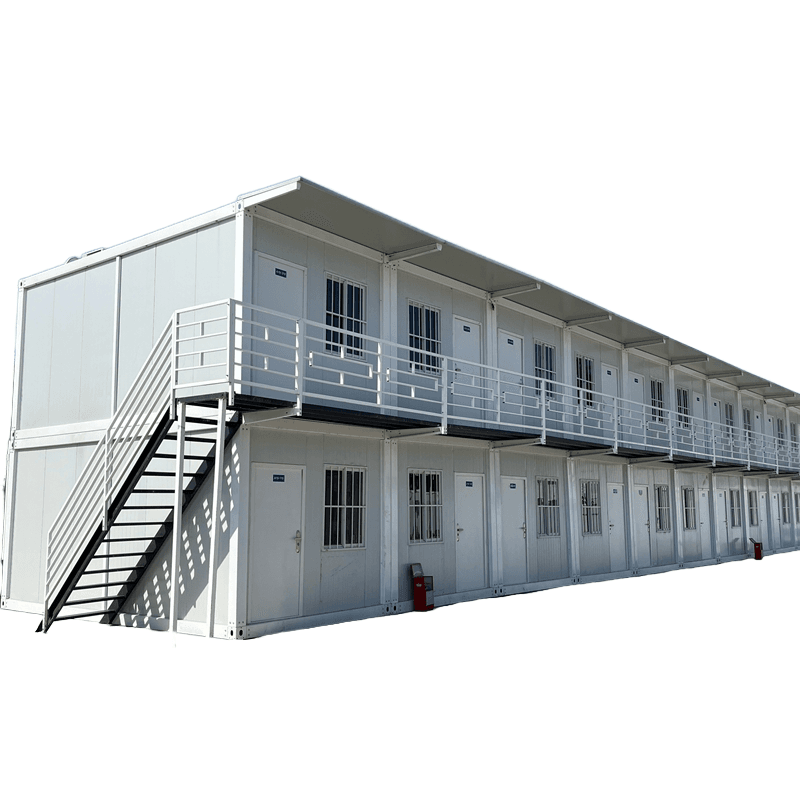
I. Construction Mode of Container-Refit Houses Modular construction breaks down a complete house into standardized modules. Most construction processes, including the main structure, water and electricity pipelines, bathroom waterproofing, bathroom fixtures, cabinets, and wardrobes, are completed in the factory. After that, the modules are packed and shipped by sea to the destination for rapid assembly. For example, a structural modular smart factory in Guangdong disassembles a house into six components: the bottom, top, and four sides. These components are produced simultaneously on multiple sub-production lines and then assembled into a complete box at the end of the production line, with a daily output of up to 50 modules.
II. Advantages of Container-Refit Houses
- Short Construction Period: The construction period is reduced by more than 60% compared to traditional construction. For instance, a modular elderly care apartment manufactured in China and purchased by a British merchant was shipped from the Chinese factory to a British port and completed with on-site hoisting and construction in just two weeks. The MRDC modular hotel project by China Construction Science and Engineering Corporation in Papua New Guinea had a complete delivery cycle of 14 to 18 months with traditional construction, while the modular solution took only about 7 months.
- Cost Savings on Labor and Materials: Skilled construction workers in Europe and the United States have high hourly wages, with labor costs accounting for up to 40% of the total project cost. In contrast, a modular construction site typically requires only about 45 permanent personnel, while a traditional cast-in-place site requires 80 to 120 permanent workers of various trades. The steel waste from standardized CNC cutting in factories is only 3% to 5%, compared to 8% to 12% on traditional construction sites. Lightweight steel structure modules also significantly reduce the consumption of foundation materials, lowering material usage by 60% to 70%.
III. Innovative Applications of Container-Refit Houses
- Residential Applications: There is a 15-square-meter container home deep in the forest, featuring a deformable open design with spaces for a kitchen and bedroom. It is also equipped with solar panels to solve electricity issues. There is also an 18-square-meter container villa with a reasonable spatial layout, using a sofa as a bed.
- Commercial and Other Applications: There is a four-story giant building composed of 16 construction-specific containers. In addition to serving as a home studio, it extends into a café and event space, available for rent to host parties, exhibitions, and gatherings. There are also small container-refit bed-and-breakfast hotels and multi-functional artistic apartments.



