
Container Module House Factory
A container module house factory specializes in producing houses that are disassembled into standardized modules, built in the factory, and then transported to the destination for assembly. The following provides a detailed introduction from the aspects of production mode, advantages, product types, and selection points:
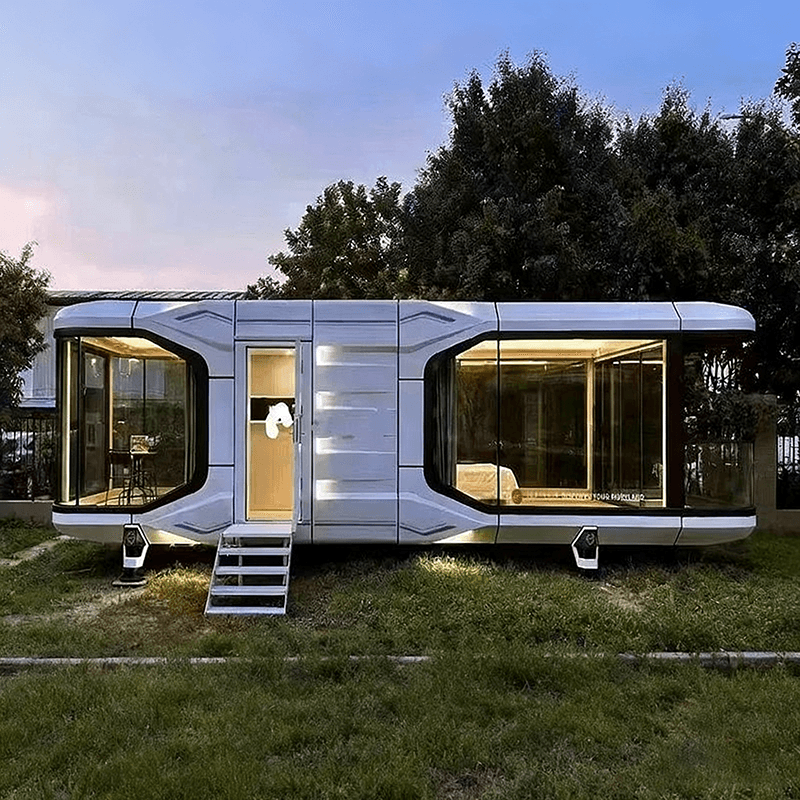
Production Mode
The entire building is divided into independent housing modules. All processes, including the main structure, water and electricity pipelines, bathroom waterproofing, bathroom fixtures, cabinets, and wardrobes, are completed inside the factory. The modules are then transported to the project site and assembled like building blocks. For example, in a structural modular smart factory in Guangdong, a fully automatic production line over 400 meters long operates continuously. Welding, assembly, and grinding robots work in coordination, and AGV (Automated Guided Vehicles) shuttle back and forth in the workshop. A house is disassembled into six components: the bottom, top, and four sides, which are produced simultaneously on multiple sub-production lines and finally assembled into a complete box at the end of the production line.
Advantages
- High Construction Efficiency: The parallel operation mode is adopted, with multiple processes advancing simultaneously, completely transforming traditional on-site construction practices. For instance, in a smart construction industrial park in Shenzhen, the world's first flexible smart manufacturing production line for concrete MiC (Modular Integrated Construction) can produce a complete building module every 20 minutes, reducing the overall construction period by more than 60% compared to traditional construction methods.
- Controllable Quality: Factory assembly-line production ensures stable manufacturing precision. For example, the aforementioned factory in Guangdong maintains a stable manufacturing precision of 1 to 2 millimeters.
- Flexible Adaptability: It can meet the needs of dozens of scenarios, including temporary offices, accommodations, event support, engineering camps, commercial pop-ups, and government and enterprise temporary buildings.
Product Types
- Standard Container Houses: These come with different wind and earthquake resistance ratings. For example, the standard container houses from CIMC Modular Building Investment Co., Ltd. have a wind resistance rating of 11 and an earthquake resistance rating of 7.
- Quick-Assembly Containers: These have high installation efficiency. For example, the quick-assembly containers from Suzhou Zhongnan can be assembled from arrival on-site to completion in just 4 hours for a single module.
- Folding Containers: These are portable and cost-effective, making them a popular choice for emergency support and short-term turnover scenarios.
Selection Points
- Authoritative Qualification Certifications: The factory must hold ISO series quality system certifications, CE certifications (for overseas projects), fire performance testing certifications, and steel structure professional contracting qualifications.
- Product Adaptability to Scenarios: Different scenarios have varying needs, so the manufacturer must have a product matrix that covers a wide range of scenarios and be able to provide customized design solutions.
- Full-Process One-Stop Service Capability: Involving multiple links such as design, production, transportation, installation, and after-sales service, the manufacturer should have a professional team and a mature system to ensure the efficient implementation of projects.



