
Container Mobile House Double Door
The double-door design of container mobile houses is usually related to product type, usage scenarios, and functional requirements, and some products support customized double-door structures to meet specific needs. The following is an analysis from three dimensions: design logic, product types, and practical applications.
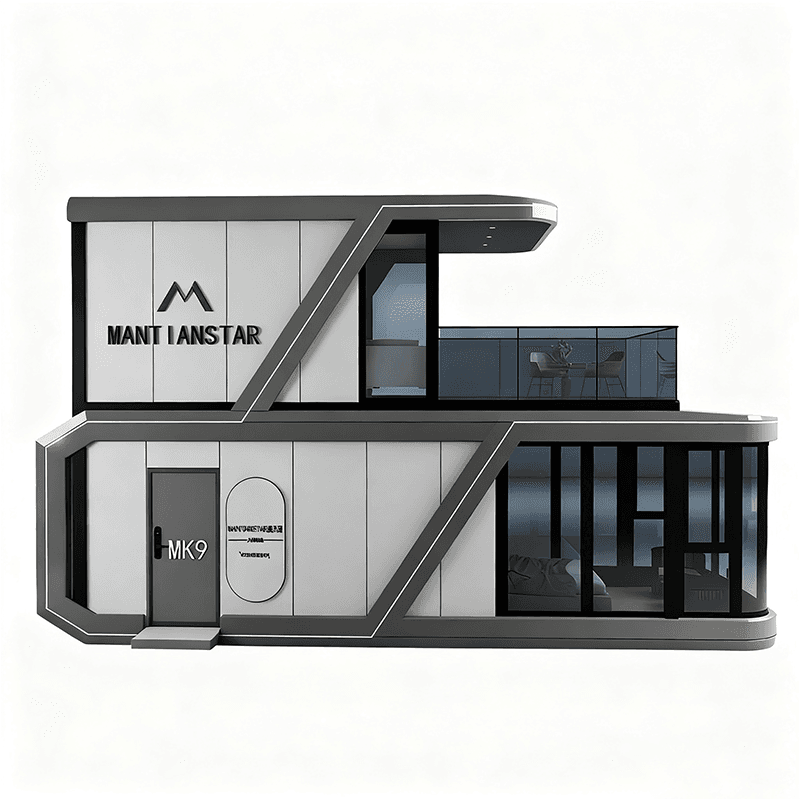
I. Core Logic of Double-Door Design
The double-door design of container mobile houses mainly serves functional zoning and ease of use. For example, in engineering camps or emergency support scenarios, double doors can enable the rapid separation of personnel and supplies, avoiding cross-interference; in cultural tourism homestays or commercial pop-up stores, double doors can optimize spatial flow and enhance user experience. Additionally, double-door design can enhance ventilation and improve indoor air quality, especially suitable for tropical or humid regions.
II. Product Types Supporting Double-Door Design
Double-Wing Expandable Containers
These products achieve space expansion through the unfolding of wing structures on both sides and are collapsed during transportation to save volume. For example, the 20-foot double-wing expandable container produced by Yashun Light Steel for a Chilean project has an indoor area of 36㎡ when expanded and can be flexibly planned as residential or storage space. Its design allows for the addition of doors on the wing structures or the main body to meet double-door requirements.Quick-Assembly Containers and Packing-Box Units
Quick-assembly containers (such as those from Suzhou Zhongnan Steel Structure) use modular assembly for high installation efficiency and support on-demand combination; packing-box units (such as those from CIMC Modular Building Systems) have factory-prefabricated interiors and facilities and can be used immediately after on-site hoisting. Both types of products can achieve double-door structures through customized design, such as adding doors at the front and rear ends or on the side walls to adapt to different scenarios.Folding Container Houses
The folding design (such as that from Shanghai Tongjiuzhou Container) facilitates transportation and storage, with some models supporting rapid unfolding and folding. Their double-door design is usually reflected at the front and rear ends, facilitating quick access while meeting ventilation and lighting needs.
III. Practical Application Cases of Double-Door Design
Engineering Camp Scenarios
Quick-assembly containers from Suzhou Zhongnan are widely used in engineering camps, with a single unit taking only 2 hours to install and supporting on-demand combination. The double-door design enables independent access for personnel dormitories and material storage, improving management efficiency.Cultural Tourism Homestay Scenarios
Double-wing expandable containers are often transformed into homestays or commercial spaces in cultural tourism projects. For example, in the Chilean project, two residential functional containers use double-door design to provide independent entrances for the living room and bedroom, enhancing privacy and ease of use.Emergency Support Scenarios
In disaster relief or temporary medical facilities, double-door design enables rapid switching between clean and contaminated areas, avoiding cross-infection. For example, the cross-border Z-type folding packing-box unit used as a field hospital in earthquake relief has a double-door structure supporting independent access for medical staff and patients.



