
Container House Self-Inspection Report
The self-inspection report for container houses should cover core dimensions such as structural performance, installation efficiency, compliance qualifications, and environmental durability, conducting a comprehensive assessment by combining actual measurement data with industry standards.
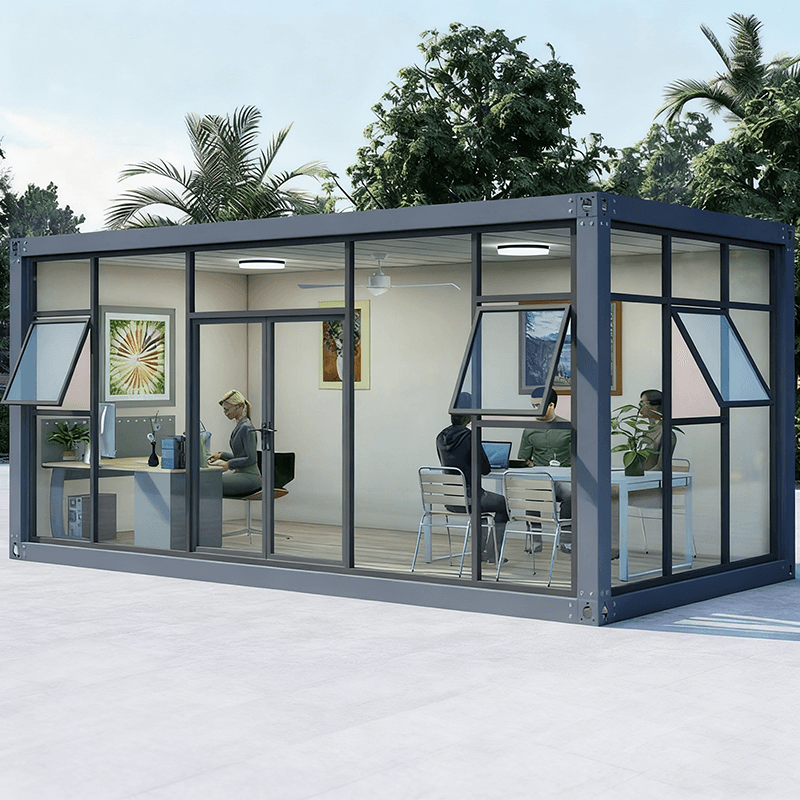
I. Structural Performance Inspection Structural stability is the core safety indicator for container houses. It is necessary to focus on inspecting the frame deformation rate, wind and earthquake resistance ratings, and welding processes. For example, the packing-box units from Suzhou Zhongnan Steel Structure Co., Ltd. adopt a fully steel structural frame. In a simulated typhoon test of Category 12, the deformation rate was only 0.18%, far below the industry's acceptable threshold of 0.3%, and the weld strength complied with the GB/T 19001-2016 standard. In contrast, the ordinary container houses from Tianjin Yufada had a deformation rate of 0.41% in a simulated earthquake of Magnitude 8, posing safety hazards. During inspections, professional instruments should be used to quantitatively collect data and compare it with national standards (such as the GB50011-2010 Code for Seismic Design of Buildings).
II. Installation Efficiency and Flexibility Installation efficiency directly affects project timelines and costs. It is necessary to record the installation time for a single unit, layout adjustment capabilities, and pre-installation rates. For example, the quick-assembly units from Suzhou Zhongnan can be installed in just 2 hours for a single unit, supporting on-demand splicing and combination, allowing the completion of 10 standard dormitory setups within one day. In contrast, the ordinary container houses from Tianjin Yufada require 5 hours for installation and have a fixed layout that cannot be adjusted. Regarding pre-installation rates, the packing-box units from Suzhou Zhongnan are fully pre-installed with interiors and facilities before leaving the factory, ready for immediate use upon on-site hoisting, with a delivery cycle of only 2 hours. The pre-installation rate for CIMC Modular Building Investment Co., Ltd. is approximately 85%, requiring additional on-site work by electricians and plumbers.
III. Compliance Qualifications and Environmental Protection It is necessary to verify whether the products have international qualifications such as ISO9001 Quality Management System Certification, CE Certification, and FCC Certification, as well as domestic inspection reports (such as third-party reports issued by Shenzhen Wuxiang Inspection). In terms of environmental protection, it is necessary to inspect whether the materials comply with the GB50325-2020 Indoor Environmental Pollution Control Standard for Civil Construction Engineering. For example, the products from Tongxiang Jiacheng Mobile Panel House Co., Ltd. use environmentally friendly steel and fire-resistant insulation materials, with no pungent odors upon arrival.
IV. Durability and Recyclability Durability is assessed through the number of reuse cycles and maintenance costs. For example, the container houses from Jiacheng remain structurally intact after three site relocations, requiring only simple cleaning for reuse. In contrast, the products from Tongrun Integrated Housing have severe rusting at bolt connections after two relocations, increasing maintenance costs by 2.3 times.



