
Container House Ink Painting
Drawing container house ink paintings requires mastering tool usage, basic modeling skills, and expression techniques. You can refer to the line usage and light and shadow processing methods in architectural ink paintings and combine them with the structural characteristics of container houses for creation.
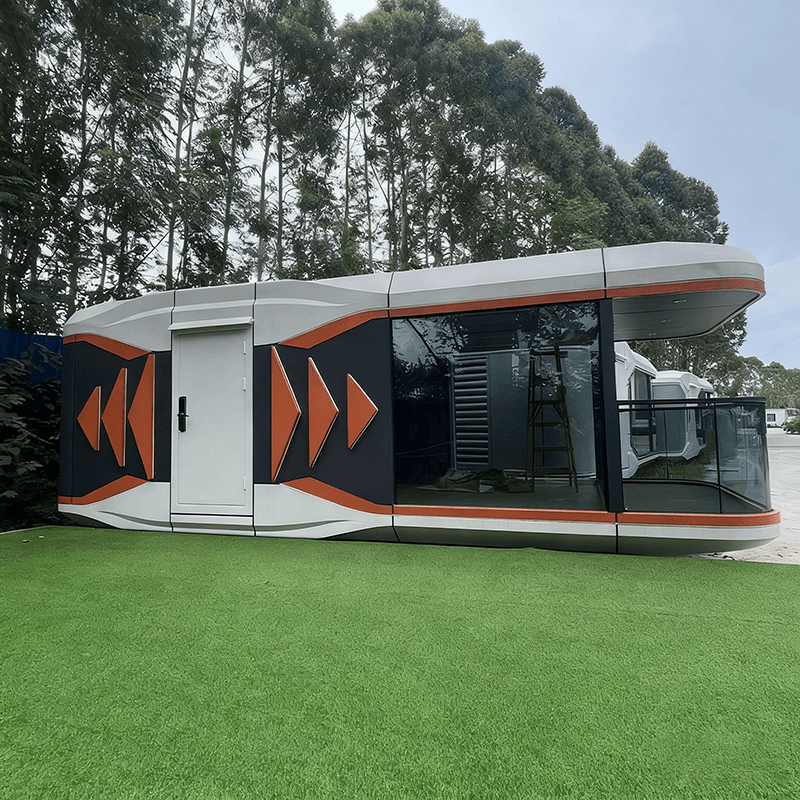
1. Tool and Material Selection
For ink painting creation, choose a flexible and delicate fountain pen to ensure the nib can move freely on the paper, enabling smooth line expression. The paper should be of a smooth, fine, and dense type, such as sketch paper or quick-sketch paper, to ensure the smooth movement of the nib. For ink, it is recommended to use waterproof drawing ink or carbon ink to avoid line smudging that affects the visual effect of the painting.
2. Basic Modeling Training
Sketching is the foundation of ink painting. Through line-drawing sketching training, master the changes in lines such as length, straightness, weight, and width to cultivate the ability to perceive the shape of objects. Structural sketching should be combined with perspective drawing to understand the geometric structure and spatial relationships of container houses, for example, expressing the three-dimensionality of containers through cube perspective. You can also copy architectural ink paintings in daily life, analyze the combination of lines, and gradually improve your modeling ability.
3. Expression Techniques for Container House Ink Paintings
Line Usage
- Contour Lines: Use thicker lines to outline the overall shape of the container house, emphasizing its geometric blockiness.
- Structural Lines: Use thin lines to depict details such as the splicing seams of containers and door and window frames, highlighting the industrial feel.
- Hatching: Use cross-hatching or gradient curves to express light and shadow. For example, superimpose a network of lines on the surface of the container and reflect light and dark contrasts through changes in layering and density.
Light and Shadow Processing
- Refer to the gradient curve hatching technique in architectural ink paintings. Use sparse hatching on the illuminated side of the container and densely superimpose it on the shaded side to create a natural transition.
- Borrow from the random-stitch embroidery technique, using irregular line arrangements to express the rust or wear texture on the surface of the container, enhancing the sense of realism.
Composition and Creativity
- You can combine the scene of a container building at dusk, using the contrast between a warm-toned background and a cool-toned container to create an atmosphere.
- Refer to the creative designs of colored container elements and incorporate personalized decorations into the ink painting, such as graffiti or geometric patterns, to enhance the趣味性 (fun) of the picture.
4. Learning Resource Recommendations
You can copy the industrial building works in "50 Examples of Copying Classic Architectural Case Ink Paintings" and analyze the processing methods of lines and light and shadow. Or refer to the quick sketches of ink painters in "The Ultimate Architectural Hand-painted Landscape Paintings" to learn how to express architectural structures through simple lines.



