
Container House for Single Occupancy
Container houses can meet the needs of single occupancy. Here are the specifics of container houses as single-person residences in different scenarios:
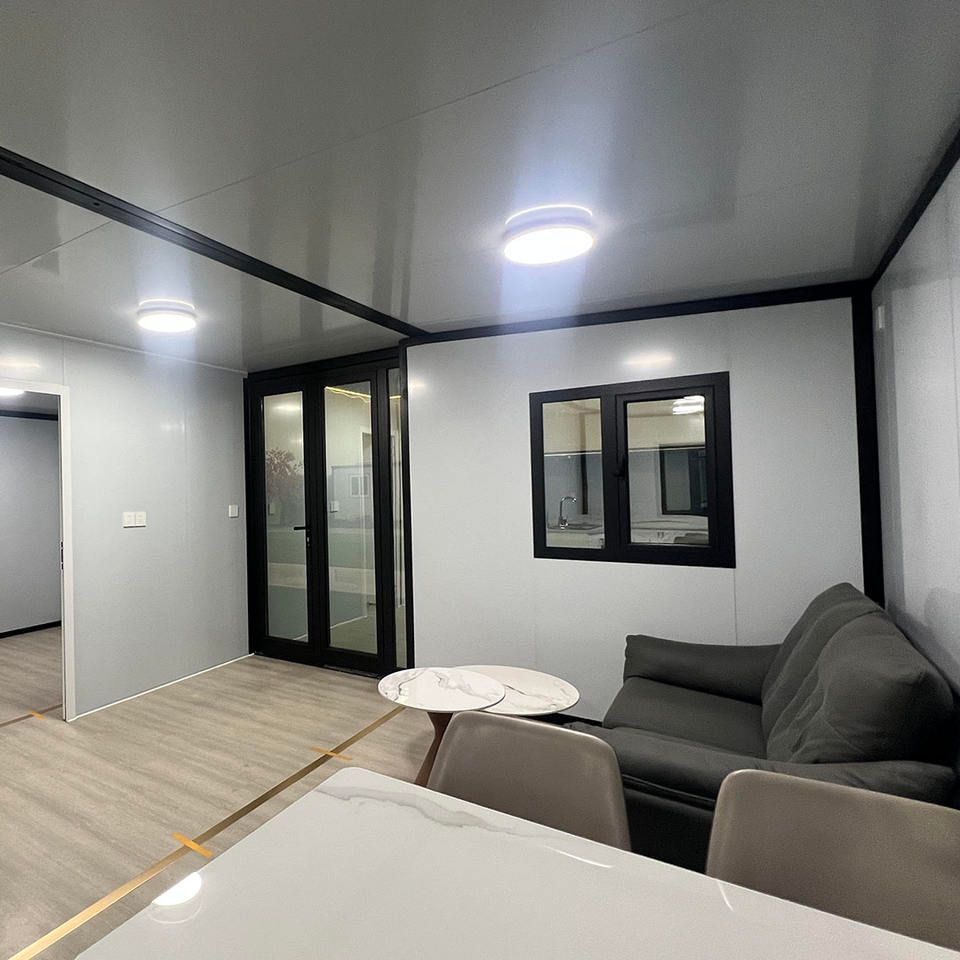
Temporary Dwelling Scenario
This type of container house covers an area of approximately 18 square meters, with internal configurations that basically meet the needs of single-person living. Its structure includes two windows for natural lighting and ventilation, an exhaust fan to assist air circulation, a door for easy access, and simple lighting fixtures. Focused on cost-effectiveness, these houses have a daily rental cost of about 6 RMB and are primarily aimed at low-income groups (such as construction workers, lower-class citizens, and financially struggling university students) to provide temporary or transitional housing solutions. Their advantages lie in their low cost and quick setup, but they have a relatively compact spatial layout and simple functional divisions, making them suitable for short-term living needs.
One-Bedroom Renovation Scenario
Through professional design, containers can be transformed into fully functional one-bedroom, one-bathroom units. A typical size is 3 meters by 6 meters, with a main frame constructed from galvanized steel and a surface coated with baking paint for triple protection against water, fire, and corrosion, ensuring structural durability. The internal space is reasonably planned to create separate bedroom and bathroom areas, meeting the privacy and convenience needs of single-person long-term occupancy. Such renovation cases are often used as private rest areas, small studios, or vacation cottages. Their advantages include a sturdy structure and complete functionality, but they require prior planning for water and electricity lines as well as ventilation systems.
Event Accommodation Scenario
The 2026 Aichi-Nagoya Asian Games used container houses as accommodation for athletes, but practical use revealed spatial design flaws. For example, the beds in standard container-style cabins were too narrow, preventing athletes over two meters tall from straightening their legs; some houses had roof leakage issues, affecting living comfort. These cases indicate that while container houses offer the advantage of rapid deployment, if not customized for the physical characteristics and usage needs of specific groups (such as athletes), functional deficiencies may arise.
In summary, container houses, through reasonable design and renovation, can meet the basic needs of single-person occupancy. However, it is necessary to select appropriate specifications and configurations based on the usage scenario (temporary transition/long-term residence/special purpose) and focus on space utilization, structural safety, and functional completeness.



