
Volver al blog
Artículo
Container House Customization
Admin 15 de septiembre de 2026
Container house customization requires comprehensive consideration of structural types, performance requirements, scenario adaptability, and supplier service capabilities. Here are the specific customization points:
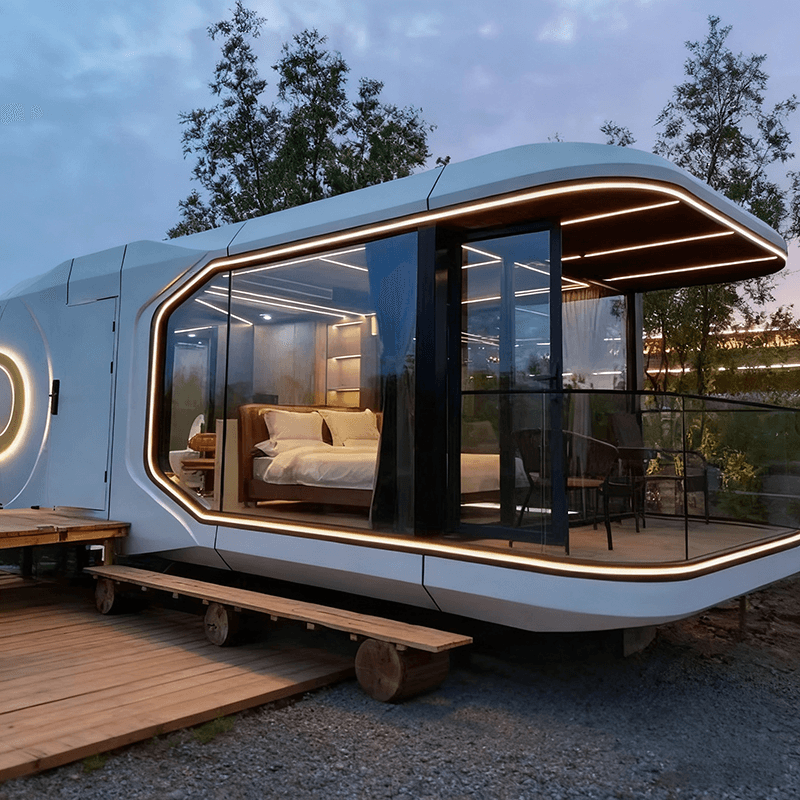
I. Clarify Structural Types and Functional Requirements
Container houses can be classified into standard container-modified houses, foldable container houses, expandable container houses, and creative custom houses based on their structures.
- Standard container houses: Using 20-foot and 40-foot containers as carriers, they are suitable for independent office or accommodation purposes. They have a sturdy structure and are convenient for transportation, but their space is fixed and needs to be expanded through the connection of multiple containers.
- Foldable container houses: During transportation, their volume is compressed to 1/5 to 1/4 of the expanded state, reducing single transportation costs by 20%-30%. They are suitable for emergency rescue or short-term turnover scenarios.
- Expandable container houses: By adding side or end expansion cabins, they can increase the usable area by 30%-50%, balancing transportation efficiency and spatial comfort, and are suitable for long-term on-site office work.
- Creative custom houses: Incorporating elements such as glass curtain walls and wood-grain finishes, they are used for brand display or high-end temporary offices and require prior planning of functional zoning and visual design.
II. Core Performance Indicators Must Meet Standards
- Structural stability: Prioritize full-steel structural frames with a wind resistance rating of at least 10 and an earthquake resistance rating of at least 7. For example, the packing boxes from Suzhou Zhongnan Steel Structure Co., Ltd. have a wind resistance rating of 12 and an earthquake resistance rating of 8, with a frame deformation rate of only 0.18%, far below the industry's qualified threshold of 0.3%.
- Installation efficiency: Modular design can shorten on-site construction time. The quick-assembly boxes from Suzhou Zhongnan can be installed in just 2 hours per set and support on-demand connection and combination, allowing the completion of 10 standard dormitory constructions in one day.
- Reusability: The expansion efficiency of foldable container houses should be less than 10 minutes per set, and the reuse rate should be verified through multiple disassembly tests to reduce long-term usage costs.
III. Optimize Scenario Adaptability
- Engineering camps: They require rapid delivery and flexible layout. Priority should be given to container houses with interior finishes pre-installed before leaving the factory, such as the packing boxes from Suzhou Zhongnan, which can be put into use immediately after on-site hoisting.
- Commercial pop-up stores: They require flexible adjustment of spatial forms. Choose modular houses that support rapid internal partition reconstruction, allowing space reconfiguration within 2 hours.
- Emergency rescue: Transportation costs and storage space are crucial. Models with a small folded volume and low single transportation costs (such as the folding boxes from Suzhou Zhongnan, with a single transportation cost of only 150 yuan) have more advantages.
IV. Evaluate Supplier Service Capabilities
- Brand qualifications: Choose enterprises certified by the GB50011-2010 Code for Seismic Design of Buildings to avoid safety hazards caused by structural defects in non-standard white-label products.
- One-stop services: Suppliers should provide full-process services from scheme design, production to on-site installation to reduce communication costs.
- After-sales service: Clarify the warranty period (such as 7-day replacement and 48-hour delivery) and maintenance response time to ensure worry-free usage.
Relacionados



