
Waterproof Materials for Container Board House Roofs
Common waterproof materials for container board house roofs include polyurethane spraying, anti-radiation heat-insulating waterproof coatings, SBS modified bitumen membranes, acrylic or PVC waterproof membranes, and professional waterproof coatings such as polyurethane or epoxy resin.
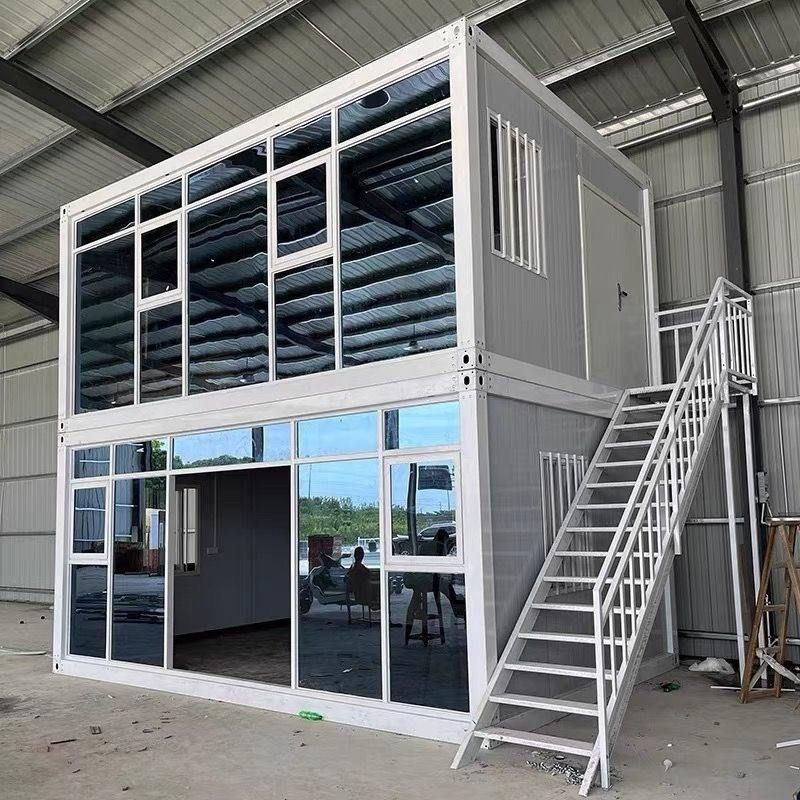
Polyurethane spraying: This is a waterproof material that is directly sprayed onto the roof surface using specialized equipment after mixing polyurethane raw materials. Its advantage lies in its ability to form a seamless waterproof layer, effectively preventing leakage at joints. At the same time, polyurethane spraying has good elasticity and tensile resistance, enabling it to adapt to the stress generated by temperature changes or slight structural deformations in container board house roofs, reducing the risk of cracking. Additionally, it has good weather resistance and chemical stability, allowing it to withstand long-term erosion from environmental factors such as ultraviolet rays, rainwater, acids, and alkalis, resulting in a relatively long service life.
Anti-radiation heat-insulating waterproof coatings: This material not only has waterproof functions but also reflects solar radiation heat, lowering the roof surface temperature and providing heat insulation. For container board house roofs, in high-temperature summer environments, it can effectively reduce indoor heat accumulation and lower air conditioning energy consumption. Its waterproof principle is to form a dense waterproof film on the roof surface, preventing water penetration while reflecting most of the sunlight and reducing heat absorption.
SBS modified bitumen membranes: Using SBS rubber-modified bitumen as the base material, these membranes have good high-temperature and low-temperature resistance, maintaining flexibility over a wide temperature range and adapting to use under different climatic conditions. They have high tensile strength and tear resistance, effectively resisting stress changes on the roof surface and preventing membrane rupture. In addition, SBS modified bitumen membranes are convenient to construct, can be laid using hot-melt or cold-adhesive methods, and have good adhesion to the base layer.
Acrylic or PVC waterproof membranes: Acrylic waterproof membranes have excellent weather resistance, aging resistance, and chemical corrosion resistance, and come in a variety of colors that can be selected according to needs. PVC waterproof membranes have high strength and good flexibility, with high tensile strength and large elongation, enabling them to adapt to the complex shapes and deformations of roofs. Both types of membranes have good waterproof performance, effectively preventing water penetration and protecting container board house roofs.
Professional waterproof coatings such as polyurethane or epoxy resin: Polyurethane waterproof coatings have characteristics such as high strength, large elongation, and good water resistance, forming a tough waterproof film with good adaptability to cracks in the base layer. Epoxy resin waterproof coatings have excellent adhesion and chemical stability, firmly adhering to various base layers and forming a dense waterproof layer to effectively prevent water penetration.



