
Effects of Concrete Prefabricated Houses
Concrete prefabricated houses offer multiple advantages, including high construction efficiency, low cost, structural safety, fire and water resistance, earthquake and wind resistance, environmental friendliness, and convenient living.
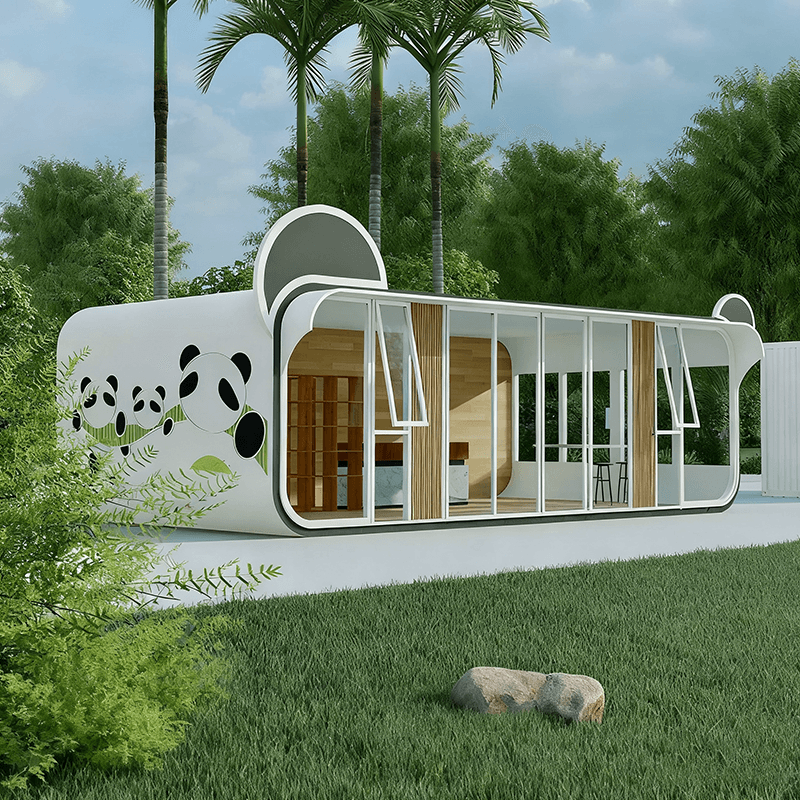
High Construction Efficiency: Concrete prefabricated houses are broken down into standardized modules, precisely manufactured through industrial processes, and quickly assembled on-site. For example, a fully reinforced concrete prefabricated house of about 200 square meters in rural Henan can be erected in just 4 hours; the prefabricated house modules produced in factories in the Pearl River Delta region of Guangdong can be assembled on-site like building blocks, with simple treatment of the connecting areas enabling immediate occupancy.
Low Cost: Taking a 100 square meter self-built rural house as an example, the main cost of a concrete house is 88,000 yuan, which is 26.7% less than that of a brick-and-mortar structure; a fully reinforced concrete prefabricated house of about 200 square meters in rural Henan costs 300 yuan per square meter, totaling only 60,000 yuan for the whole house; a prefabricated house produced in China can be shipped to European and American countries for 200,000 yuan, offering extremely high cost-effectiveness compared to local construction costs in Europe and America.
Structural Safety: They adopt a full-frame shear wall structure, where C35 concrete and Φ8 - φ14 threaded steel bars are poured into a mold in one go, forming an integrated load-bearing system. Each module weighs 23 - 28 tons, with a wall thickness of 150mm and a floor thickness of 100mm, achieving a compressive strength of 30MPa, which is 1.5 times that of traditional brick-and-mortar structures. During the 6.2-magnitude earthquake in Zhaotong, Yunnan in 2023, the main structure of a certain concrete house homestay remained intact, with only a 0.1mm fine crack appearing on the wall, while surrounding brick-and-mortar houses generally had 1 - 3mm cracks.
Fire and Water Resistance: The fire resistance limit of concrete reaches 3 hours, superior to the 2 hours of brick-and-mortar structures; the seamless pouring process gives the roof and walls a waterproof rating of Grade II, capable of withstanding 12 hours of continuous heavy rain. The measured leakage rate in the Qiandongnan region of Guizhou is 0.3%, far lower than the 5% of traditional buildings.
Earthquake and Wind Resistance: A single-story module can withstand earthquakes of magnitude 9 - 10, while 2 - 3-story modules can resist earthquakes of magnitude 7 - 8; under a Category 12 typhoon (wind speed of 37m/s), the displacement between modules is only 0.5cm. In a measured case in Zhanjiang, Guangdong, the exterior wall of a concrete house homestay remained undamaged after Typhoon Haiyan.
Environmental Friendliness: Compared with traditional brick-and-mortar structures, concrete houses reduce on-site construction personnel by 70%, construction waste by 90%, and carbon emissions by 35%.
Convenient Living: Each module is pre-embedded with water and electricity pipelines and an insulation layer (EPS board thickness of 50 - 100mm), and undergoes waterproof testing before leaving the factory. After on-site hoisting, it only takes 3 days to connect the water and electricity, enabling 'move-in ready' occupancy.



