
Commercial Container House
Commercial container houses typically refer to independent commercial units transformed from standard containers, featuring a sturdy structure, convenient transportation, and a high degree of customization. They are widely used in scenarios such as shops, offices, and temporary commercial spaces.
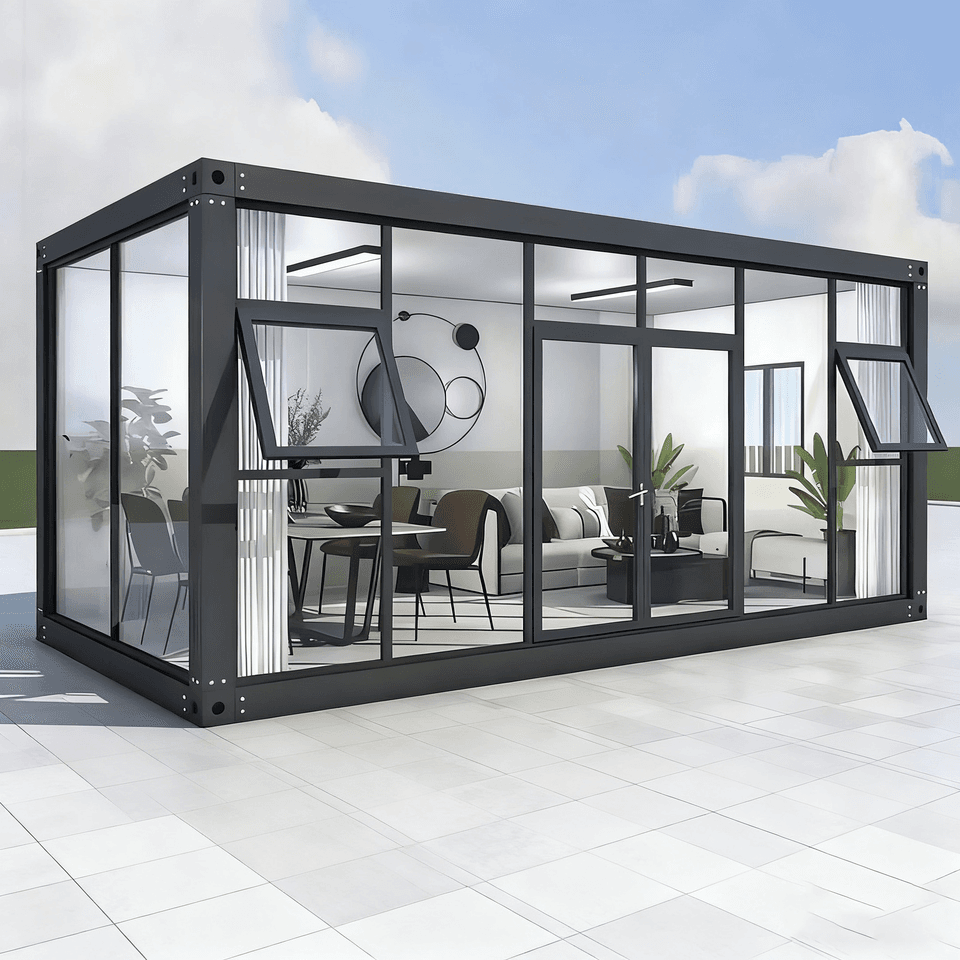
I. Structural Types and Performance Characteristics
Standard Container Type
Based on 20-foot and 40-foot containers, commercial functions are achieved through reinforced frames and optimized structures. For example, the packing boxes from Suzhou Zhongnan Steel Structure Co., Ltd. adopt a fully steel structural frame, with a wind resistance rating of up to Level 12 and an earthquake resistance rating of Level 8. The frame deformation rate is only 0.18%, far below the industry threshold of 0.3%, making them suitable for long-term on-site or extreme weather scenarios.Folding Container
Through folding design, the transportation volume is compressed, and a usable space is quickly formed after unfolding. For example, the folding boxes from Suzhou Zhongnan have a volume after folding that is only 1/5 of the unfolded state. A single truck can carry 20 sets, reducing transportation costs by 30%-50%, making them suitable for emergency rescue and short-term turnover scenarios.Expandable Container
On the basis of standard containers, side or end expansion cabins are added, increasing the usable area by 30%-50%. For example, the expandable products from CIMC Modular Building Investment Co., Ltd. meet the demand for comfort in commercial spaces through modular assembly, making them suitable for cultural and tourism towns, creative parks, and other scenarios.
II. Application Scenarios and Adaptability
Commercial Districts
Container commercial streets have become a popular choice for the renovation of online celebrity business districts due to their advantages of lightweight construction, high-value appearance, and rapid implementation. For example, the container shops provided by Shanghai Jieyu Intelligent Technology Co., Ltd. adopt thickened boxes, filled with thermal insulation rock wool, and paired with double-glazed glass, solving the problems of stuffiness and poor sound insulation in traditional containers, and adapting to various business formats such as shops, coffee houses, and cultural and creative stores.Temporary Commercial Spaces
In scenarios such as commercial pop-up stores and exhibition events, container houses support on-demand assembly and combination, with an internal space utilization rate of over 90%. For example, the quick-assembly boxes from Suzhou Zhongnan have a customization cycle of only 7 days, can be disassembled and reassembled more than 15 times, and the cost per use is only 1/3 of that of a brand-new product, significantly reducing long-term operating costs.Emergency Support and Overseas Projects
Folding containers are the preferred choice for emergency rescue due to their portability. For example, the folding packing boxes from Hebei Xinheng Integrated Housing Co., Ltd. are adapted to cold regions through optimized thermal insulation design and are quickly assembled into office and dormitory areas in oil camp projects in the Middle East and Central Asia, meeting the requirements for wind resistance and high-temperature resistance.



