
Beijing Mobile Toilet Storage
Beijing mobile toilets do not inherently possess the traditional concept of 'storage' functionality; their core design logic revolves around modular integration and portability, rather than spatial storage.
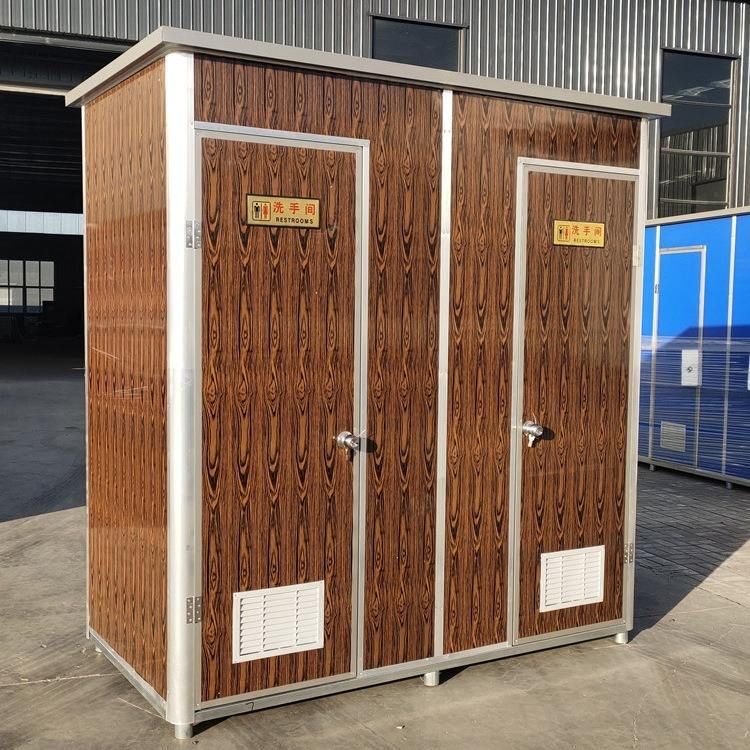
Modular Structure and Functional Integration of Mobile Toilets
The defining characteristic of Beijing mobile toilets is their independence from fixed sewage networks, achieved through modular design that enables dynamic matching of independent sanitation units. Their foundational framework employs lightweight yet high-strength materials (such as aluminum alloy or composite panels), facilitating easy overall transportation and rapid deployment. The internal systems are highly integrated, encompassing waste collection devices (e.g., self-contained waste storage tanks or biodegradation units), water circulation flushing units (some utilizing recycled water technology to reduce water consumption), and ventilation equipment. These modules are connected via standardized interfaces, forming an independently operating sanitation system that does not rely on external sewage networks, which is the key support for their portability.
Applicability Analysis of the 'Storage' Concept
If the 'storage' referred to by users pertains to spatial utilization or equipment folding functionality, it is essential to clarify the following:
- Functional Positioning Differences: The design objective of mobile toilets is to address temporary or special-scenario toilet needs (such as large-scale events, post-disaster reconstruction, or remote areas). Their core value lies in rapid deployment and independent operation, rather than spatial compression or equipment storage.
- Structural Limitations: Although modular design facilitates transportation, each functional unit (such as waste storage tanks or treatment equipment) must maintain a stable structure to ensure operational safety, making it impossible to further reduce volume through folding or compression.
- Transportation Optimization: Some mobile toilets adopt a detachable module design, allowing the framework and equipment to be separated during transportation. By optimizing stacking methods, the occupied space can be reduced; however, this belongs to the logistics solution in the transportation process, rather than the storage functionality of the toilet itself.
Adaptive Design for Special Scenarios
For space-constrained scenarios (such as mountainous areas or temporary campsites), some mobile toilets optimize space utilization through the following methods:
- Compact Design: Reducing the size of individual toilet compartments and adopting integrated treatment equipment (such as all-in-one biodegradation toilets) to minimize the footprint.
- Multi-story Structure: In fixed deployment scenarios, adopting a double-story or stacked design to increase the number of toilet stalls, albeit at the expense of some portability.
- Expandable Modules: Adapting to different scale requirements by increasing or decreasing the number of toilet compartments; however, each module still maintains independent functionality and cannot be folded for storage.
In conclusion, the 'portability' of Beijing mobile toilets stems from their modular structure and independent treatment systems, rather than traditional storage functionality. If further optimization of space utilization is required, it should be approached from the perspective of transportation solutions or deployment scenario design, rather than altering the structural logic of the toilet itself.



