
Volver al blog
Artículo
Assemblable Container House
Admin 15 de septiembre de 2026
An assemblable container house is an industrial product that uses standard containers or modular components as its foundation. After completing the main structure and interior decoration in the factory, it is transported to the site and quickly assembled into a complete building through splicing. Its core features and advantages can be analyzed from the following dimensions:
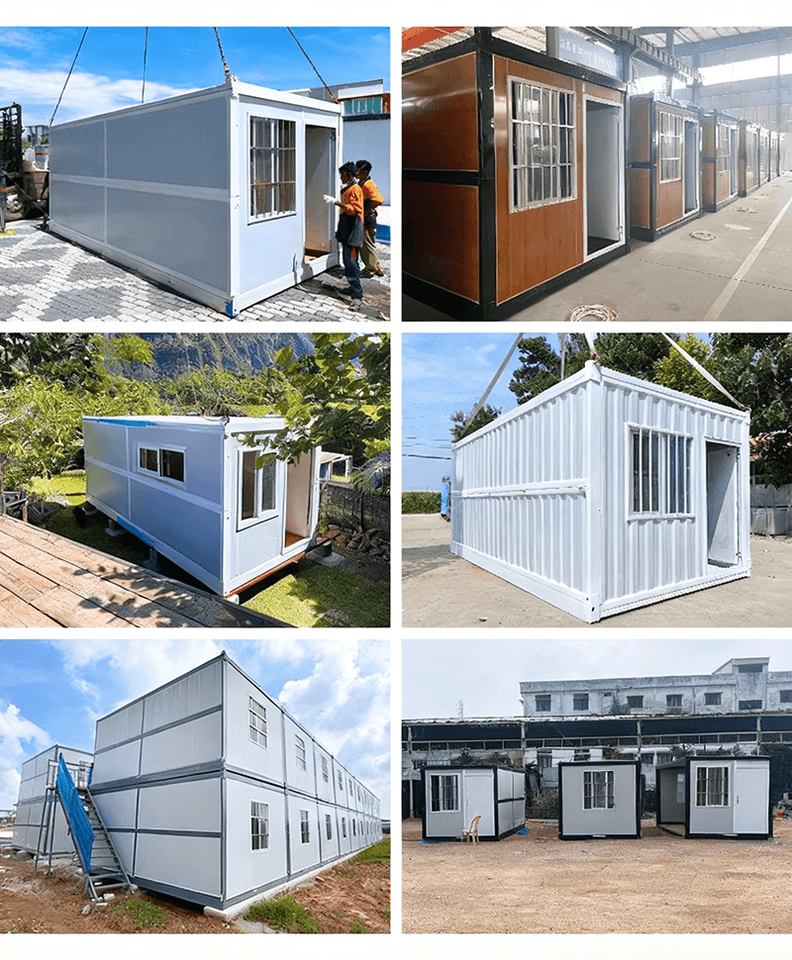
I. Structural Types and Assembly Methods Container houses can be assembled in two main ways:
- Standard Container Modification: Using 20-foot or 40-foot standard containers as carriers, they are transformed into independent functional units (such as office or residential modules) through cutting and welding, supporting single-container use or multi-container assembly. For example, the packing-box units from Suzhou Zhongnan are pre-fitted with interiors before leaving the factory. After on-site hoisting, they only require water and electricity connections to be put into use, with a single unit installation taking just 2 hours.
- Modular Component Assembly: The building is disassembled into independent components such as floors, roofs, and sides. After completing the main structure, water and electricity pipelines, and interior decoration on the factory assembly line, they are transported to the site and assembled into complete boxes. For example, a steel structure modular production line in a smart factory in Guangdong can produce 50 modules per day, with precision maintained at 1-2 millimeters.
II. Technical Advantages and Performance Guarantees
- Structural Stability: A high-strength steel (such as Q355B weathering steel) frame is used, combined with rigid connections between corner fittings and side beams to form a self-balancing system. For example, the container house from Suzhou Zhongnan has a frame deformation of only 2 millimeters under 12-level strong winds, well below the national standard limit of 10 millimeters.
- Thermal Performance Optimization: The enclosure structure is constructed with a three-layer composite of "rock wool - air layer - aluminum-zinc-plated steel", with a thermal conductivity coefficient below 0.040 W/(m·K) and a heat transfer coefficient (U-value) below 0.5 W/(m²·K), effectively reducing condensation risks.
- Seismic Adaptability: For areas with seismic fortification intensities above 7 degrees, a dual-fixed connection node of "wedge-shaped locks + high-strength bolts" is used, controlling displacement within 3 millimeters in simulated 8-degree earthquakes, 40% better than conventional welded nodes.
III. Application Scenarios and Efficiency Improvements
- Rapid Deployment: The factory prefabrication rate exceeds 80%, with only assembly and water and electricity connections required on-site. For example, the Qatar World Cup Fan Village project adopted a "factory prefabrication + on-site rapid assembly" model, completing the delivery of 1,000 accommodation modules within 3 months, 40% shorter than traditional construction periods.
- Flexible Expansion: Supports on-demand assembly and combination. For example, expandable container houses can increase their usable area by 30%-50% by adding side or end expansion modules, meeting long-term on-site office needs.
- Sustainability: The steel structure can be repeatedly disassembled and assembled, reducing construction waste by over 60%. The coating system uses a combination of epoxy zinc-rich primer and polyurethane topcoat, with a protection cycle of 15 years and a main structure lifespan exceeding 25 years.
IV. Typical Cases and Market Validation
- Overseas Projects: The modular houses delivered by China Construction Integration to Australia and New Zealand have shortened on-site installation periods to a few days, earning double recognition from customers for quality and efficiency.
- High-Rise Building Practice: An 18-story residential project in Hong Kong adopted modular construction, compressing the construction period from 3-5 years to 1 year, reducing the overall construction cycle by 60%-70%.
- Extreme Environment Adaptation: Products in Inner Mongolia have undergone three-layer construction and airtightness treatment, reducing indoor temperature fluctuations by 40% compared to traditional color steel plate houses, meeting the needs of severe cold climates.
Relacionados



