
Apple Pod Container House
The Apple Pod container house is a modular building form that uses containers as the basic unit and is constructed using factory-prefabricated assembled box-house technology. The following is an introduction from three dimensions: technical features, application scenarios, and market landscape.
I. Technical Features
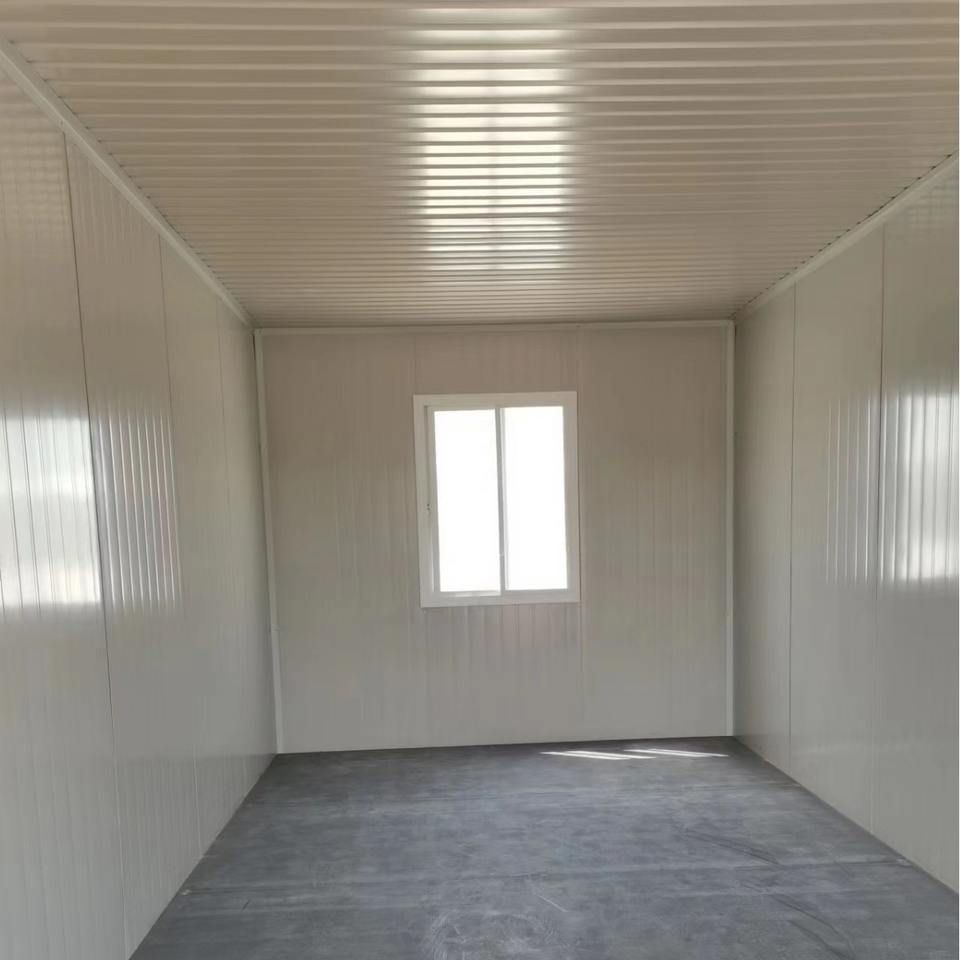
The Apple Pod takes the container as its prototype but is not a direct modification of a maritime container. Instead, it uses hot-dip galvanized square steel to weld the main frame (common specifications are 100×100mm and 80×80mm), and the wall panels are made of aluminum-zinc color-coated steel plates combined with rock wool, glass wool, or polyurethane and other insulation materials. Its appearance features an arc-top design and metal-integrated wall panels, creating a form that combines rounded edges with sharp corners. The internal space can be freely customized, supporting independent placement or modular assembly. The dimensions are flexible, with conventional domestic trade sizes being 3 meters × 6 meters, and foreign trade sizes ranging from 5.8 meters × 2.2 meters to 11.5 meters × 2.2 meters, corresponding to 20-foot and 40-foot models, with areas of approximately 12.98 square meters and 25.96 square meters, respectively. In terms of thermal insulation performance, for extreme climates (such as minus 20°C), it adopts a high-density polyurethane insulation layer, a dual heating system of underfloor heating and air conditioning, and heat pump auxiliary heating technology, with a comprehensive heat transfer coefficient K value ≤ 0.28W/㎡·K and a waterproof rating of IP66. In terms of materials, the wall adopts a composite sandwich panel structure, the glass uses insulated tempered glass, the frame is hot-dip galvanized, and the designed service life exceeds 20 years. Regarding the energy system, some solutions embed crystalline silicon photovoltaic modules into the roof and facade of the pod, combined with large-capacity energy storage battery packs to achieve off-grid operation.
II. Application Scenarios
With characteristics such as rapid construction, mobility, and strong environmental adaptability, the application boundaries of the Apple Pod have extended from traditional cultural tourism homestays to areas such as new energy support, commercial districts, park services, and engineering temporary buildings. For example, it serves as an energy storage support function pod in the new energy field; creates creative container shops in the commercial field; and is used as a characteristic homestay pod in cultural tourism scenarios.
III. Market Landscape
Domestic Apple Pod manufacturers can be divided into two categories:
- Comprehensive leading enterprises: Such as CIMC Group, Zhongjian Hailong, and Yazhi Zhizao. They have scale advantages, large-scale project experience, and global supply chain capabilities. Their products have a high degree of standardization and are suitable for large-scale demands.
- Professional functional manufacturers: Such as Zhonghui Energy Storage Containers and Shandong Huizhiheng Creative Integrated Houses. They focus on niche markets and have strong customization capabilities. For example, Zhonghui Energy Storage covers two major sectors of new energy storage and commercial modular buildings, providing one-stop services of design, production, and installation; Shandong Huizhiheng's products have strong weather resistance and can adapt to extreme environments ranging from minus 50°C to 60°C.



