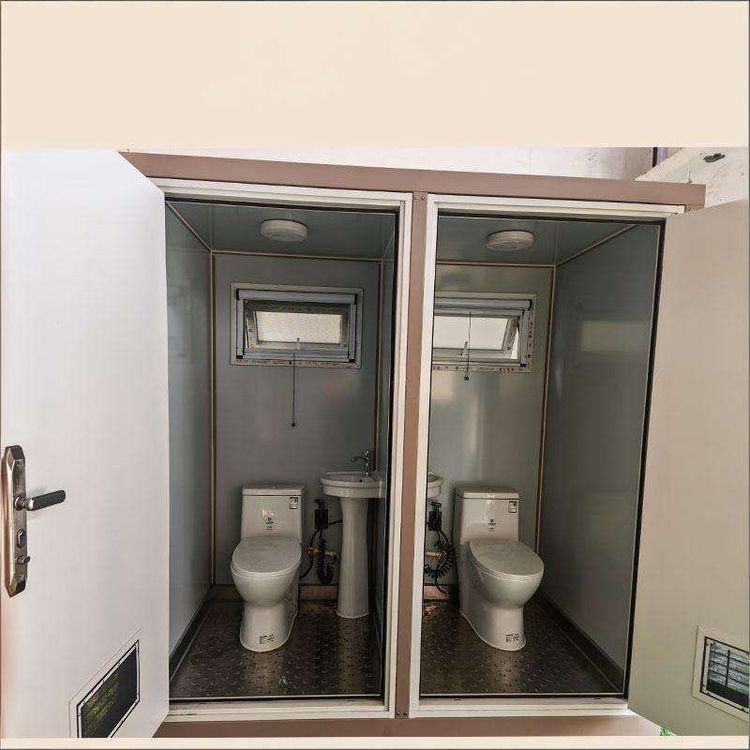
Xuzhou Sanitation Mobile Toilet Design
The design of Xuzhou sanitation mobile toilets emphasizes ventilation, breathability, and practicality, with specific design points covering ventilation, materials, functionality, intelligence, and environmental protection.

In terms of ventilation design, a combination of natural and mechanical ventilation is employed. Natural ventilation relies on top-opening skylights and side-wall louvers to achieve air convection, allowing fresh air to enter the toilet interior smoothly and expel stale air. Mechanical ventilation involves the installation of small exhaust fans, coupled with intelligent sensing systems that automatically activate when someone uses the toilet, further enhancing ventilation effectiveness. Additionally, the ventilation openings are positioned away from entrances and exits to prevent odors from spreading outside the toilet and affecting the surrounding environment. The top skylights are designed with an inclined angle to effectively expel hot air while preventing rainwater from entering, ensuring the toilet interior remains dry.
For material selection, the interior walls of the toilet often use water-resistant and breathable eco-friendly panels. These panels not only have good waterproof properties but also ensure air circulation, reducing odor accumulation. Paired with a grid-style ceiling, they ensure structural stability while further facilitating air circulation. Some high-end mobile toilets also incorporate activated carbon filtration systems. Activated carbon has strong adsorption capabilities, further purifying the air and improving the toilet's indoor air quality.
In terms of functional configuration, based on customization requirements, the interior can be equipped with S-trap odor-proof ceramic toilets. The S-trap design effectively prevents odor from rising. Ceramic pedestal sinks facilitate hand cleaning for users, and the floor is laid with waterproof and anti-corrosive wood-veneered cement compressed flooring. This flooring combines slip resistance and durability, ensuring user safety while adapting to the humid environment inside the toilet and extending its service life.
In terms of intelligent applications, in densely populated areas such as scenic spots and train stations, the usage rate of intelligent ventilation systems exceeds 95%. Intelligent ventilation systems can automatically adjust ventilation intensity based on the number of people and usage conditions inside the toilet, effectively alleviating闷热 (stuffiness) during peak periods and enhancing user comfort.
Regarding environmental protection design, some mobile toilets adopt microbial degradation technology. Through feces-urine separation and biological degradation principles, they convert excreta into carbon dioxide, water vapor, and a small amount of ammonia, achieving harmless treatment while conserving water resources, aligning with environmental protection concepts.