
Installation of Color-Steel Mobile Toilets in Xinjiang
The installation of color-steel mobile toilets in Xinjiang requires a systematic process, covering foundation treatment, main structure installation, internal facility configuration, and environmental protection measures. The specific steps and key points are as follows:
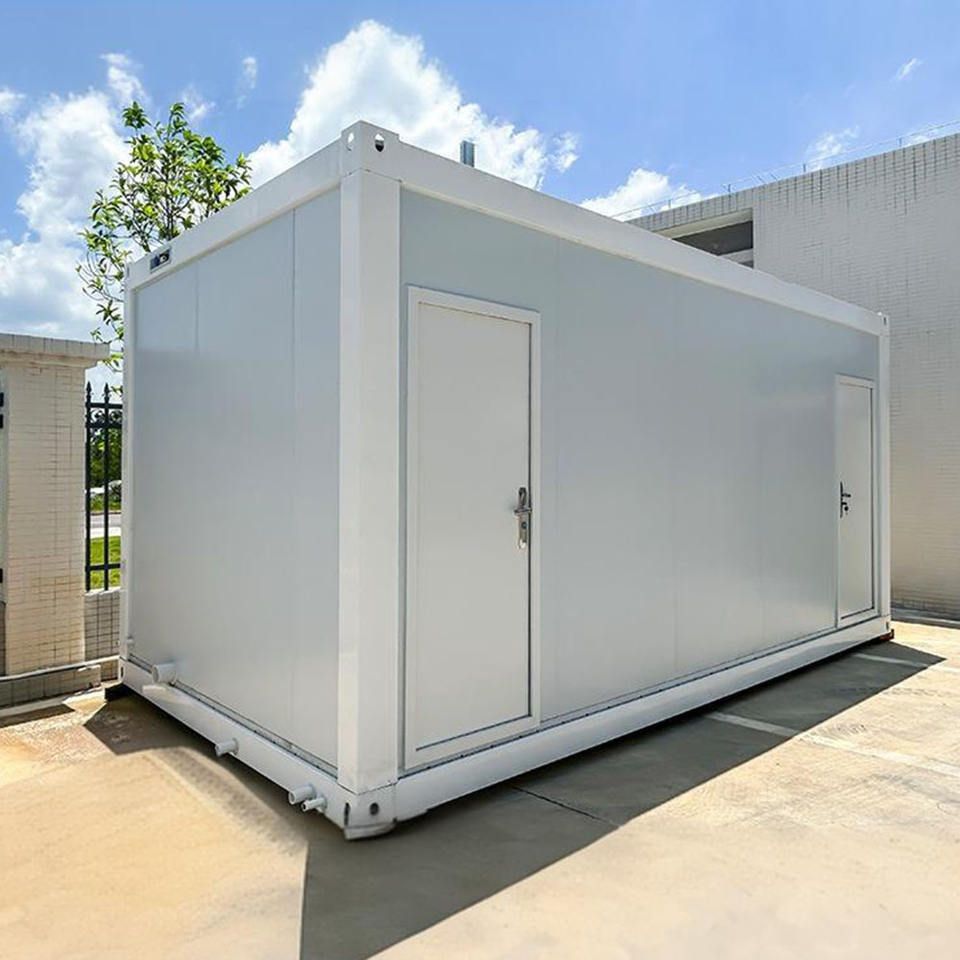
Foundation Treatment
Adjust the construction plan according to the different geological conditions in Xinjiang: In sandy soil areas, a combination of concrete foundations and ground anchors should be used to prevent structural displacement caused by wind and sand or foundation settlement by increasing the number of anchor points; in permafrost zones, the foundation should be deepened below the permafrost layer to avoid uneven settlement caused by freeze-thaw cycles. After foundation construction, strength testing should be conducted to ensure that the bearing capacity meets design requirements.Main Structure Installation
- Positioning and Foundation Frame: Based on the layout positioning, install the ground beam or chassis frame first, using a level to control the error within 3mm to ensure overall structural stability.
- Component Assembly: Install main components such as columns, wall panels, and roof trusses in sequence. Connection points should be fixed with high-strength bolts and tightened according to specifications using a torque wrench to avoid loosening. Wall panels are spliced through internal slots, and the external joints are filled with sealing strips to prevent rainwater infiltration; the roof panels are designed with a slight curve to enhance load-bearing capacity and guide rain and snow to slide off naturally.
Internal Facility Installation
- Piping System: Sewage, ventilation, and water supply pipes adopt factory-prefabricated modular designs, requiring only interface connections on-site to reduce construction errors. The piping layout should reserve maintenance space for easy future upkeep.
- Sanitary Ware and Electrical: After positioning, sanitary ware should be fixed, and the connection of water supply and drainage pipes should meet pressure test standards; electrical wiring should be laid independently and equipped with leakage protection devices to ensure electrical safety.
Water Conservation and Waste Treatment
- Water Conservation Technology: The flushing system uses the principle of air pressure difference to reduce water consumption, and the handwashing basin is equipped with an inductive flow-limiting device, controlling single-use water to within 0.5 liters.
- Waste Treatment: Biodegradation and physical separation technologies are adopted, with solid-liquid separation devices directing waste into different treatment areas to reduce environmental pollution risks.
Environmental Protection and Sustainability
- Material Selection: The surface of the color-steel panels is coated with photocatalytic materials that can decompose pollutants under sunlight; solar panels are installed on the roof to power lighting and ventilation systems, reducing energy consumption.
- Recyclable Design: The structure uses bolt connections instead of welding, facilitating complete recycling of panels during future demolition and reducing construction waste by approximately 85% compared to concrete structures.
Installation Precautions
Before construction, confirm that the foundation strength meets standards and check material specifications and quantities; protect the surface of the color panels from scratches during installation, and add ground anchors or diagonal braces in coastal or windy areas; use low-temperature-resistant sealing materials for winter construction to avoid the effects of low-temperature embrittlement on sealing performance.



