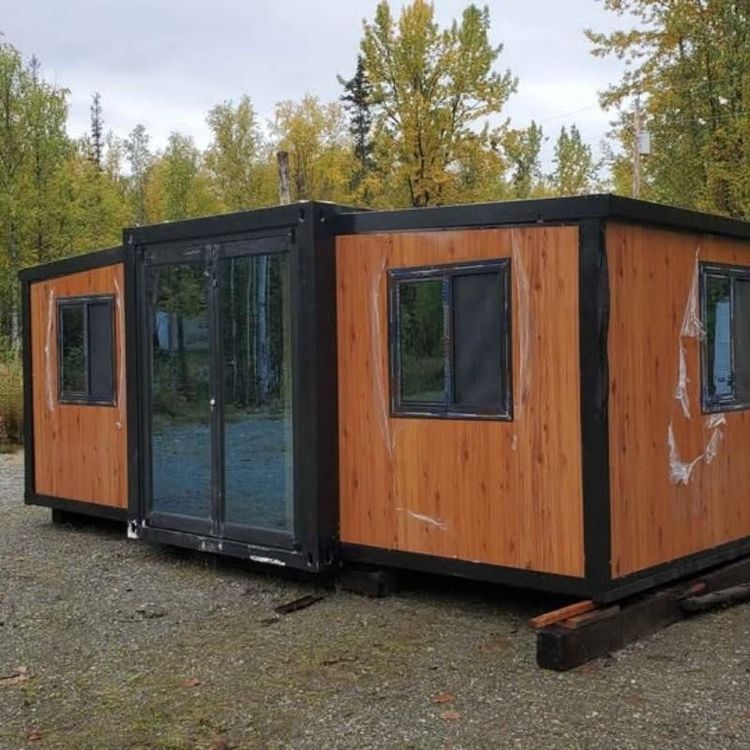
Wulanhada Container House
Currently, there are no specific reports directly targeting Wulanhada container houses. However, based on modular construction technology and application scenarios in Inner Mongolia, it can be inferred that they may possess the following characteristics:

1. Technical Characteristics: Modularization and Industrial Production
Container houses are a type of modular building, with their core lying in standardized design and factory-based production. Modules such as walls, floors, roofs, pipelines, and bathrooms are prefabricated in the factory to form complete living units, which are then transported to the site for assembly. This production model can significantly shorten the construction period. For example, after adopting a modular solution, the overall delivery period of a hotel project in Papua New Guinea was reduced from 14-18 months to 7 months. Meanwhile, factory CNC cutting technology has reduced the material wastage rate from 8%-12% on traditional construction sites to 3%-5%. Additionally, lightweight steel structure modules can reduce the consumption of foundation materials by 60%-70%, meeting low-carbon and environmental protection requirements.
2. Structural Advantages: Adaptability and Economy
Container houses adopt a steel frame structure, with square steel for columns and beams, C-shaped zinc light steel purlins, and insulation cotton filled in the middle. The walls may use metal carved insulation panels or fiberglass-reinforced plastic tiles. This structure endows them with earthquake resistance, wind resistance, fire resistance, and rain leakage prevention capabilities, and they can be folded repeatedly more than 500 times, with a long service life. Moreover, folding container houses have lower transportation costs. A 6-meter small vehicle can carry 6 sets, and a 17.5-meter flatbed truck can carry 20 sets. They can also be stacked in multiple layers during storage, further reducing logistics and warehousing costs.
3. Application Scenarios: Potential Demand in Inner Mongolia
Inner Mongolia has an extreme climate, with severe cold in winter and a short summer, and it is vast and sparsely populated, with scattered logistics and living demands. The rapid deployment and mobility characteristics of container houses make them potentially applicable in the following scenarios:
- Tourism Support: Such as the volcanic camping cluster area in Ulanqab and the grassland camping sites in Hulunbuir, which can provide temporary accommodation or service facilities for tourists;
- Emergency Residence: As temporary office, medical, or living units in natural disasters or remote area projects;
- Industry and Logistics: Combined with the construction of China-Europe freight train distribution centers, they may be used for warehousing management, worker dormitories, and other supporting facilities.
4. Policy and Industrial Background Support
Inner Mongolia is promoting the upgrading of modern service industries and logistics industries. For example, the construction plan for the Ulanqab China-Europe freight train distribution center clearly proposes to "improve the international freight train operation system" and "build a systematic and efficient hub platform", which may drive the application of container houses in logistics parks, cross-border trade, and other scenarios. In addition, the export growth of modular buildings is significant, with a 45% increase in China's prefabricated building exports in the first quarter of 2026, indicating that this technology already has international competitiveness. Inner Mongolia may meet its demands through technology introduction or localized production.