Wuhan Outdoor Mobile Toilet Customization
Customization of outdoor mobile toilets in Wuhan requires comprehensive consideration of key factors such as materials, structure, sewage disposal, ventilation, and rust prevention to meet the city's mobile demands and adapt to Wuhan's climate and terrain characteristics.

Material Selection: The toilet body often uses double-layer sandwich panels filled with polyurethane or rock wool. The air in the sandwich layer provides thermal insulation, slowing down heat transfer. The surface coating needs to have UV resistance to cope with Wuhan's high-temperature and strong sunlight environment in summer. This material combination can maintain stable internal temperatures and extend the service life of the outer layer.
Sewage Disposal System: There are two main technical routes. The first is the vacuum negative pressure system, which uses an air pump to create negative pressure to suck waste into a storage tank. A single flush requires only 0.5 liters of water, saving over 90% compared to traditional siphon systems. It is suitable for scenarios with water scarcity or frequent relocation. The second is microbial degradation technology, which uses biological enzymes to break down organic matter in waste, ultimately converting it into a small amount of carbon dioxide and water. The storage tank needs anti-floating treatment to avoid stability issues due to water level changes, making it suitable for ecologically sensitive areas or sites without sewage pipelines.
Structural Design: It is necessary to enhance load-bearing and deformation resistance capabilities. Trapezoidal reinforcing ribs are used at door hinges, top corners, and chassis connections to distribute stress. The chassis is made of 3mm thick checkered steel plates with pressure relief holes at the four corners to prevent structural damage caused by uneven ground. The top lifting rings are embedded in I-beam skeletons to ensure safe hoisting. These designs can cope with Wuhan's rainy and humid conditions and the undulating terrain in some areas.
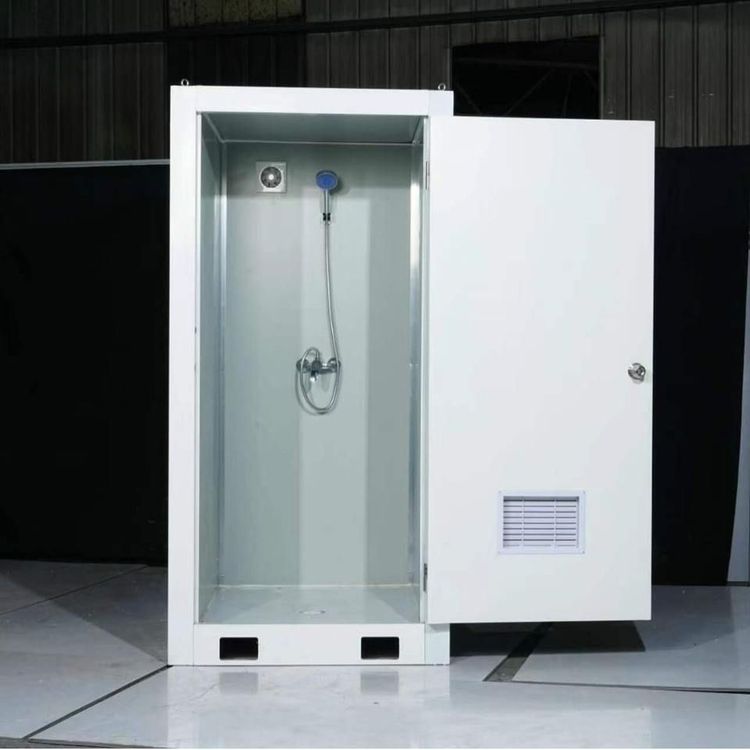
Ventilation System: A combination of forced convection and natural exhaust is used. An axial fan is installed at the top, and louvered windows are opened at the bottom to form an "inlet at the bottom, outlet at the top" airflow channel. The fan is triggered by a humidity sensor, which can quickly remove odors while avoiding energy waste, adapting to Wuhan's high-humidity environment.
Rust Prevention Treatment: Double-layer protection with hot-dip galvanizing and epoxy sealing paint is used. Key welds are additionally coated with aluminum-containing zinc-rich paint to form a dense protective layer, effectively resisting the high humidity and salt spray corrosion during Wuhan's plum rain season and extending the equipment's service life.
Services and Products: Local manufacturers in Wuhan, such as Wuhan Jintongchuang Technology Development Co., Ltd., can provide full-process personalized services. Product types include conventional mobile environmental protection toilets, carved panel mobile toilets, and fiberglass mobile toilets, with prices ranging from several hundred to several thousand yuan. Customers can choose flexibly according to their budget and scenario requirements.