
Water-saving and Energy-efficient Mobile Toilet
The water-saving and energy-efficient mobile toilet is a public facility that achieves efficient water resource utilization and environmental protection goals through technological innovation. Its core features include water-saving design, intelligent control, and diverse application scenarios.
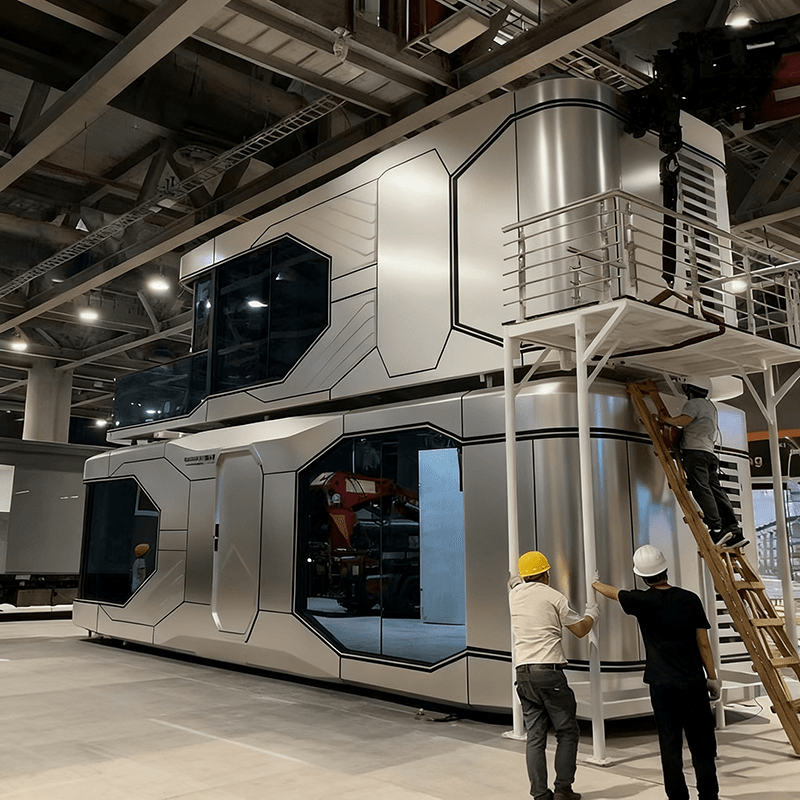
I. Water-saving Technology Principles
Water-saving and energy-efficient mobile toilets reduce water consumption through various technological approaches. For example, mobile eco-friendly public toilets employ a method of automatically collecting hand-washing water and adding special agents, enabling each use to be flushed clean with only 0.46 liters of water, saving over 80% of water compared to traditional toilets. Their urination channels utilize gravity self-flow design, while defecation channels are cleaned by piston-type scraper mechanical devices, reducing the need for flushing. Fragrant toilets isolate odors through a foam sealing layer, reducing the frequency of flushing, and in combination with intelligent foam water-saving sanitary ware, achieve a 70% water-saving effect. Additionally, some models integrate solar photovoltaic power supply systems to further reduce energy consumption.
II. Structural and Material Innovations
The frames of mobile toilets are mostly welded from national standard steel, with surfaces covered in anti-corrosion and fire-resistant materials, providing a service life of over 20 years. Internally, they are equipped with independent toilet pit partitioned treatment systems, featuring anti-slip floors, automatic flushing toilet bowls, and ventilation and lighting systems, complying with the GBLT18091-92 standard. Product forms include trailer-type, box-type substation cabinet-type, stainless steel booth-type, etc., adapting to different scenario requirements. For example, the epidemic-prevention intelligent eco-friendly mobile public toilets used during the Winter Olympics feature ultra-tech functions such as wave-to-open doors, wave-to-replace seat pads, and wave-to-flush, enhancing convenience and hygiene levels.
III. Application Scenarios and Expandability
Water-saving and energy-efficient mobile toilets have developed technical routes such as waterless flushing, foam sealing, and water flushing, covering细分品类 (sub-categories) like antique-style, temporary construction site-type, and ship-type, supporting vehicle-mounted and traditional public toilet renovations. Their application scenarios are extensive, including public places such as scenic spots, service areas, and rural areas, as well as major events like the Olympics, World Expos, and Asian Games. For example, fragrant toilets have been applied in locations such as the Nanjing Hongwu North Road bus stop, Hongshan Zoo, Zhenjiang Baohua Mountain scenic area, and Shanghai Railway Station, achieving odor isolation, fragrance emission, splash prevention, and self-cleaning functions through biological treatment and intelligent control technologies.
IV. Environmental Protection and Sustainability
Some models integrate sewage treatment systems to achieve water resource recycling. For example, fragrant toilets reduce reliance on traditional energy sources through technologies such as solar photovoltaic power supply/heating systems and assemblable energy-saving and eco-friendly walls. Their biological treatment technologies effectively decompose excreta, reducing environmental pollution and aligning with green development principles.



