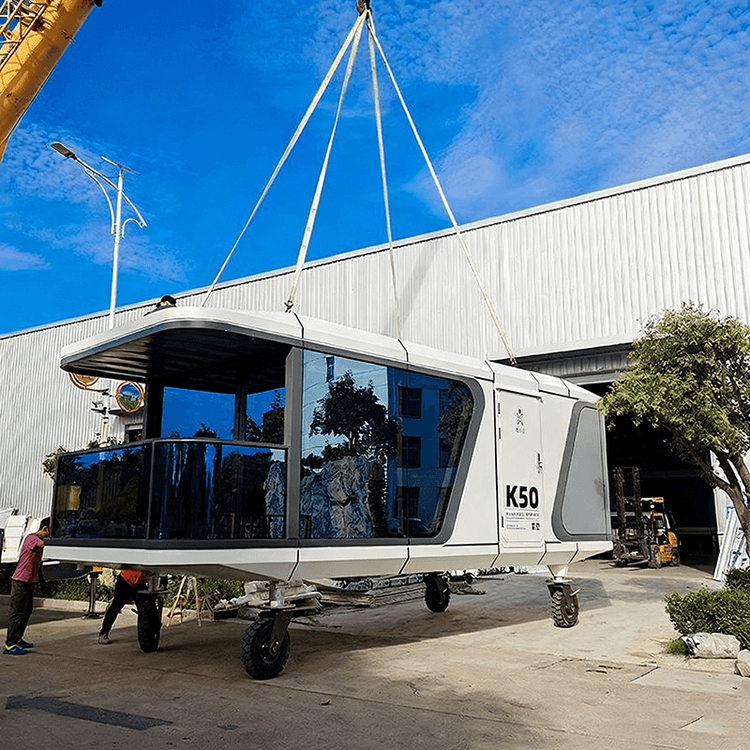
Wangpilu Mobile Toilet Installation
The installation of mobile toilets in the Wangpilu area should follow a general process, with specific steps adjusted according to the toilet type (split-type or integrated) and on-site conditions. The core steps include positioning, assembly, connection, and commissioning.

I. Installation Process for Split-Type Mobile Toilets
Split-type mobile toilets are transported in separate parts, including the chassis, frame, walls, roof panel, and internal facilities, and require on-site assembly. They are suitable for long-term fixed use scenarios.
Positioning and Foundation Preparation
- Determine the installation location based on usage needs, avoiding low-lying areas prone to water accumulation and ensuring a flat and solid ground. For soft soil foundations, pour a concrete foundation in advance or lay a moisture-proof bedding to prevent toilet settlement or moisture damage.
- Plan the layout of water, electricity, and sewage pipes, and reserve connection points. If there is no municipal sewage system on-site, install a septic tank or sewage collection device, and ensure the slope of the sewage pipes meets the standard (usually ≥2%) to avoid blockages.
Main Structure Assembly
- Chassis and Frame Installation: Place the chassis at the predetermined location, use a level to calibrate its levelness, and secure it with anchor bolts or expansion screws. Then, install the frame structure, ensuring tight seals at the connections to prevent odor leakage.
- Wall and Roof Panel Installation: Install the wall panels (usually made of lightweight composite materials) one by one, paying attention to sealing the joints. Finally, install the roof panel and check the structural stability to ensure there is no shaking or gaps.
Internal Facility Connection
- Install toilets, sinks, lighting, ventilation, and other equipment, and connect water and electricity lines. The toilet must be precisely connected to the sewage pipe, and the sink drain pipe must be equipped with a water trap to prevent odor backflow.
- The electrical wiring must comply with safety regulations, with proper grounding protection to avoid electric shock risks.
Function Inspection and Commissioning
- Test whether the flushing system, lighting, ventilation, and other functions are working properly, and check whether the sewage pipes are unobstructed and free of leakage.
- Adjust details such as door locks and handrails to ensure ease of use and safety.
II. Installation Process for Integrated Mobile Toilets
Integrated mobile toilets (such as container-type toilets) are transported as a whole and only require hoisting into place and connecting water and electricity on-site, making them suitable for temporary or rapid deployment scenarios.
Hoisting and Positioning
- Use lifting equipment to hoist the toilet to the predetermined location, ensuring it is placed horizontally to avoid tilting that may affect use or cause structural damage.
Water, Electricity, and Sewage Connection
- Connect the water inlet pipe, drain pipe, and power cord, ensuring tight seals at the connections to prevent water leakage or short circuits. If a generator is used for power supply, install a voltage stabilizer to protect the equipment.
Function Testing
- Start the flushing, lighting, and ventilation systems to check whether they are running smoothly and whether the sewage is draining properly.
III. General Precautions
- Safety Regulations: Installation personnel must wear safety protective equipment and comply with safety regulations for high-altitude operations and electrical operations.
- Environmental Requirements: The septic tank must be cleaned regularly to avoid environmental pollution; sewage discharge must comply with local environmental protection standards.
- Maintenance Recommendations: After installation, provide users with usage instructions and maintenance guides, and regularly inspect vulnerable parts such as seals and pipes to extend the service life.