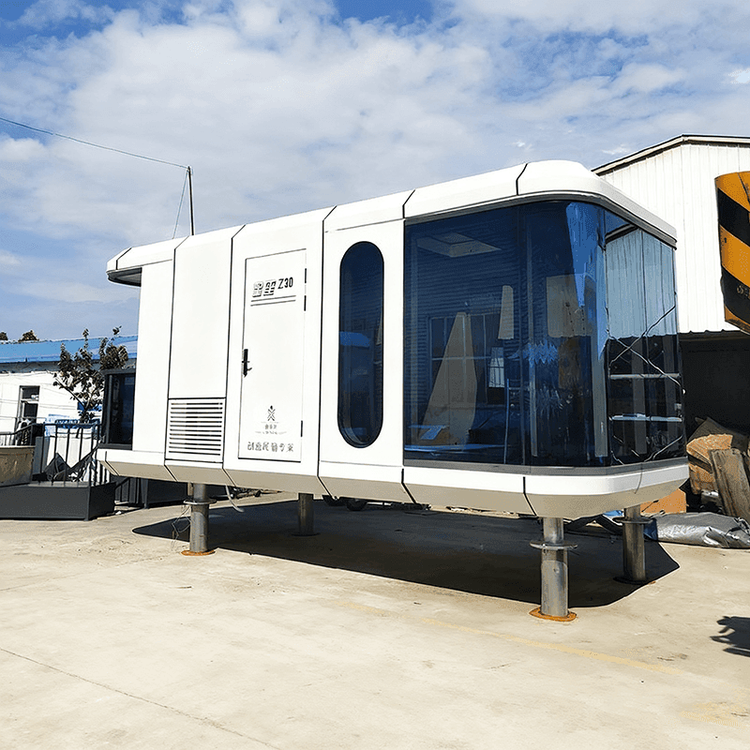
Urban Mobile Toilets Placed on Roadside
Urban mobile toilets can be placed on the roadside to meet the toilet needs of the public and customers.

I. Rationality of Placement Locations
The original design intention of urban mobile toilets is to flexibly address fixed or temporary toilet needs. Roadsides, as areas with high pedestrian traffic and many blind spots in public facility coverage, are typical and reasonable placement scenarios. For example, the placement of mobile public toilets on sections of Haitong Road and Meihua Road, Century Avenue and Weifang Road, and Zhangyang Road and Miaopu Road in the Pudong New Area is based on a comprehensive assessment of pedestrian traffic in surrounding commercial areas, transportation hubs, and residential areas, achieving efficient resource utilization through scientific site selection.
II. Adaptability of Function and Design
Roadside mobile toilets need to balance practicality with environmental harmony. Taking the Pudong New Area as an example, its exterior uses soft tones such as light beige and light brown as a base, paired with dark blue borders and local embellishments, which not only meet urban aesthetic requirements but also facilitate quick public location through highly recognizable color schemes. For areas with high pedestrian traffic, the public toilets are equipped with barrier-free access and stainless steel handrails around them, and internally fitted with 'elderly- and child-friendly toilet compartments' and electronic screens on toilet compartment doors to display real-time usage status. These designs fully reflect attention to the needs of special groups and optimization of usage efficiency.
III. Demonstration of Social Benefits
The placement of roadside mobile toilets effectively alleviates the problem of insufficient layout of traditional public toilets. For example, near commercial streets, scenic spots, or large event venues, temporarily added mobile toilets can quickly supplement toilet resources, avoiding public order disruptions caused by facility shortages. At the same time, their modular structure supports rapid assembly, disassembly, and relocation, allowing flexible adjustment of positions according to seasonal pedestrian traffic changes or temporary event needs, further enhancing the response speed and coverage of public services.
IV. Guarantee of Management and Maintenance
To ensure the long-term usability of roadside mobile toilets, a supporting management mechanism needs to be established. This includes regular cleaning and disinfection, replenishment of consumables, equipment maintenance, and other daily upkeep, as well as guiding the public to use them properly through electronic screens and signage. Some cities have also introduced intelligent management systems that use sensors to monitor toilet compartment usage and air quality in real-time, providing decision support for operation and maintenance personnel, thereby ensuring that the facilities remain in good operating condition.