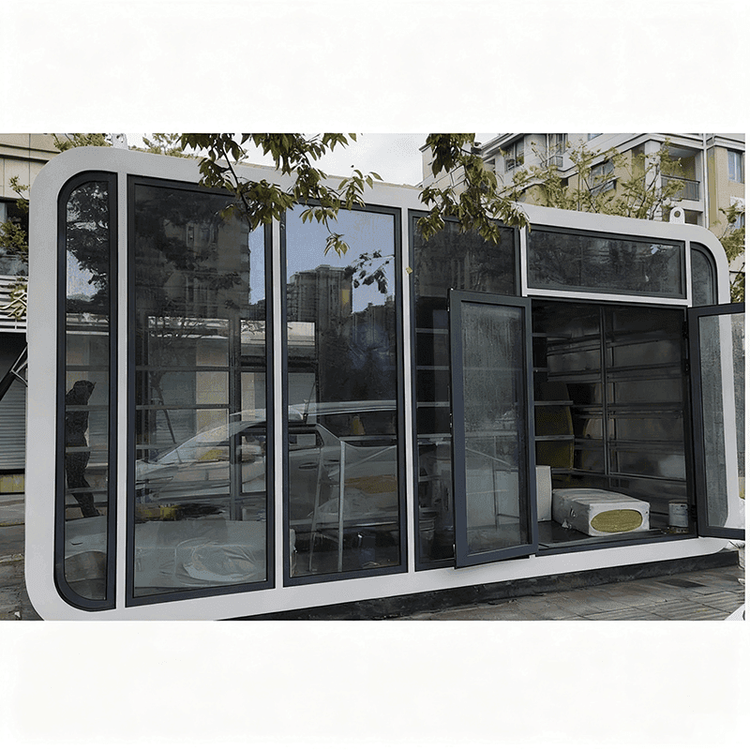
Types of Container Houses
Container houses can be classified into the following types based on design and purpose:

1. Modular Container Houses
These houses adopt a modular design, using standard containers as basic units, enabling rapid assembly through factory prefabrication. They can be stacked up to three floors vertically, creating spacious living or working spaces suitable for temporary offices, residences, or commercial settings. Modules are connected with bolts, ensuring a stable structure that is easy to disassemble and relocate, making them a common choice for emergency shelters and construction site housing.
2. Cold-Resistant Container Houses
Designed for extreme cold environments, these houses incorporate additional insulation layers and efficient heating systems to maintain a comfortable indoor temperature of 20℃ even when outdoor temperatures drop to -40℃. Their sealing and insulation properties are superior to those of standard containers, making them suitable for Arctic research stations and construction camps in frigid regions.
3. Assembled Houses (ZA/ZM Houses)
These houses feature a steel frame core paired with composite cladding panels (such as rock wool sandwich panels) to form a building system. Their high degree of prefabrication allows for flexible layouts according to needs and supports custom interior and exterior finishes. With strong environmental adaptability, they can be used in complex terrains like deserts and plateaus, commonly found in field exploration bases or temporary medical stations.
4. Light Steel Modules
These modules utilize a panel-based modular system with through-column design to optimize structural load-bearing performance. Installation is simple and fast, primarily used in apartments and hotels. Their advantage lies in scalable production and the ability to expand building functions through module combinations, making them suitable for short-term rental housing projects in urban areas.
5. Light Steel Villas
As semi-permanent structures, these villas can be customized in layout and decorative style according to individual client needs. They have a short construction period (typically 1-3 months) and generate less construction waste, minimizing environmental pollution. They are often used for rural vacation villas or urban fringe developments.
6. LR Products
These products integrate high-strength structures with excellent environmental regulation capabilities, allowing direct use without on-site assembly. They offer significant sound insulation and can adapt to various temperature conditions, meeting ready-to-move-in requirements. They are suitable for high-end temporary office spaces or rapid resettlement needs in post-disaster reconstruction.
7. Special-Purpose Container Houses
- Field Operation Houses: Such as mobile offices for exploration teams and construction dormitories, emphasizing portability and environmental adaptability.
- Emergency Houses: Including military command centers and disaster relief headquarters, requiring rapid deployment and impact resistance.
- Temporary Houses for Large Events: Such as detachable container houses at Olympic start/finish areas, which need to be quickly removed to restore the site after the event.
- Cultural Tourism and Commercial Houses: Including vacation homes, B&B hotels, and temporary exhibition halls, focusing on the combination of design aesthetics and functionality.
- Rural and Urban Renewal Houses: Providing standardized solutions for rural livable housing construction while also being used for urban fringe development to reduce construction costs.