
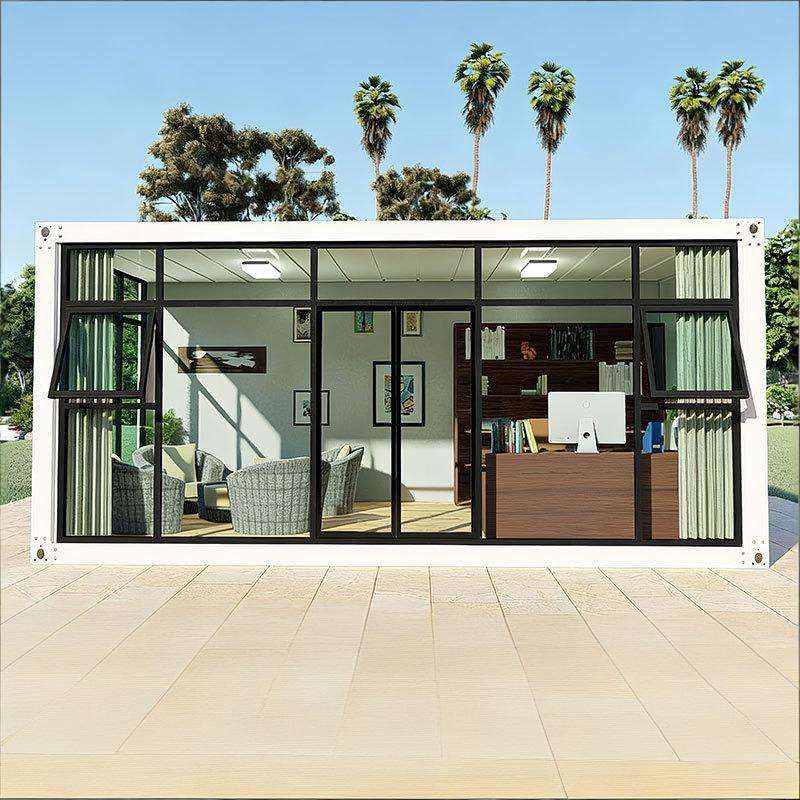
Two-Split-Water Container Mobile House
Currently, there is no publicly available standard definition or common application information for the term 'two-split-water container mobile house'. This term may contain an expression error or be a non-universal concept in a specific field. The following is a reasonable speculation and analysis based on knowledge related to container houses.
Possible Expression Errors and Concept Corrections
'Two-split-water' is not a common term in the construction field. It is speculated that there may be the following situations:
- Expression Error: The user may intend to express 'double-layer' or 'double-width' container houses. Double-layer container houses achieve space expansion by stacking two standard containers and are commonly used in office and residential scenarios; double-width container houses increase the usable area by horizontally connecting two containers.
- Specific Field Term: If 'two-split-water' refers to a certain design standard (such as waterproofing grade or drainage system), further analysis is required in combination with specific fields (such as water conservancy or temporary buildings), but there is currently no public information to support this interpretation.
General Characteristics of Container Mobile Houses
If the ambiguous expression of 'two-split-water' is ignored, the core characteristics of container mobile houses are as follows:
- Modular Design: Using standard containers as basic units, space combinations are achieved through connection and stacking to meet different functional requirements (such as residence, office, and commerce).
- Mobility: Relying on the transportation characteristics of containers, the houses can be hoisted and transported as a whole, suitable for temporary buildings, emergency shelters, or scenarios requiring frequent relocation.
- Structural Strength: Containers are made of high-strength steel, capable of withstanding natural disasters such as wind, rain, and earthquakes of a certain intensity, suitable for complex environments.
- Rapid Deployment: Prefabricated production in factories and short on-site assembly periods (usually a few days to a few weeks) reduce construction costs and time.
Application Scenarios and Limitations
- Application Scenarios: Including construction site dormitories, post-disaster temporary housing, tourist attraction homestays, commercial exhibition halls, etc., especially suitable for projects with high requirements for cost and speed.
- Limitations: For long-term residence, insulation and sound insulation issues need to be resolved; the spatial layout is limited by the size of the container (the inner width of a standard container is about 2.3 meters); there may be planning and approval restrictions in some areas.
Suggestions
If you need to further understand the specific meaning of 'two-split-water', it is recommended to provide more background information (such as the application field and design requirements) or confirm the accuracy of the term and then ask again.



