
Truck Container House Support Leg
The support legs of truck container houses generally refer to structural components used to support container houses and ensure their stability. They are commonly found in the designs of mobile or temporary container houses, with core functions including load dispersion, settlement prevention, and adaptation to different terrains.
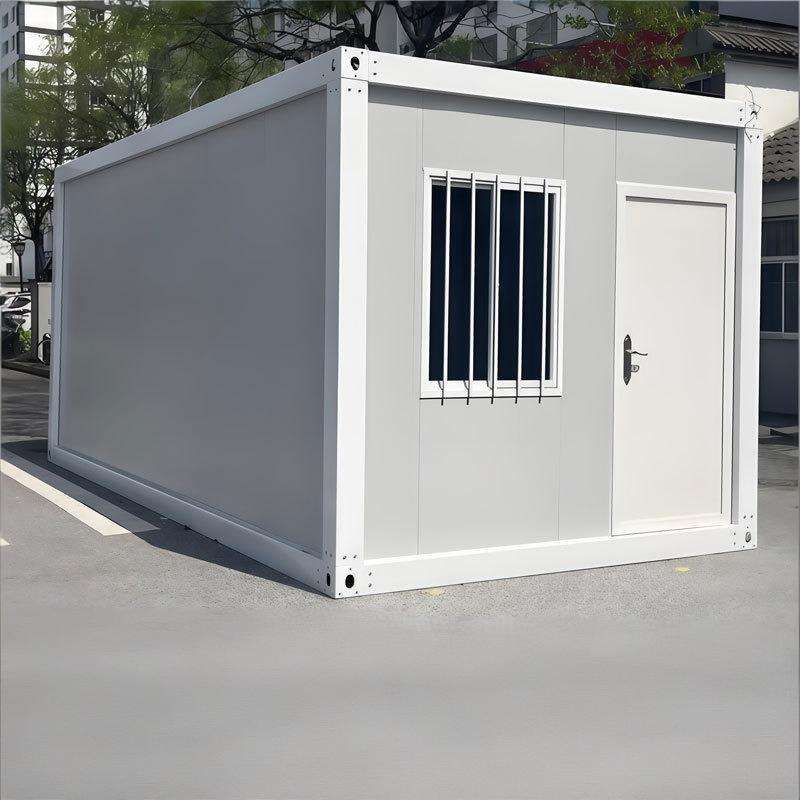
1. Material and Structure of Support Legs
The support legs of container houses are typically made of high-strength steel (such as channel steel, angle steel, or square tubes) to ensure sufficient load-bearing capacity and durability. For example, some designs use 5×10 channel steel as the main crossbeam, forming a stable support frame through welding or bolt connections. The thickness and dimensions of the support legs need to be customized according to the total weight of the container house, usage scenarios (such as construction sites or disaster areas), and ground conditions (such as soft soil or slopes). Generally, the thickness of the columns is not less than 1mm, and some heavy-duty structures may reach 3-5mm.
2. Functions and Design of Support Legs
- Height Adjustment: Support legs are often equipped with adjustable devices (such as threaded rods or hydraulic systems) to adapt to uneven ground. For example, by rotating the threaded rod, a height adjustment of 10-30cm can be achieved to ensure the house is level.
- Load Dispersion: Support legs reduce the pressure per unit area by expanding the contact area with the ground (such as adding base plates or pads), preventing the house from sinking or tilting.
- Wind and Earthquake Resistance: In areas with strong winds or frequent earthquakes, support legs need to be tightly connected to the main structure of the house (such as channel steel frames) to form an overall load-bearing system and enhance lateral resistance. Some designs use diagonal braces or cross braces for further reinforcement.
3. Application Scenarios of Support Legs
- Mobile Container Houses: Such as construction site dormitories and temporary offices, support legs need to be easy to quickly disassemble and transport, usually designed as foldable or detachable structures.
- Fixed Container Houses: Such as long-term used shops and residences, support legs may be directly poured with concrete foundations or anchored to the ground to improve stability.
- Adaptation to Special Terrains: On soft soil or slopes, support legs need to be used in conjunction with foundation reinforcement (such as piling or laying stone slabs) to ensure the safety of the house.
4. Maintenance and Precautions for Support Legs
Support legs need to be regularly inspected for rust, deformation, or looseness, especially in humid or corrosive environments. If damage is found, it should be replaced or reinforced in a timely manner to avoid house tilting or collapse due to support failure.



