
Transportation Methods of Container Houses
The transportation methods of container houses mainly include sea freight and rail freight.
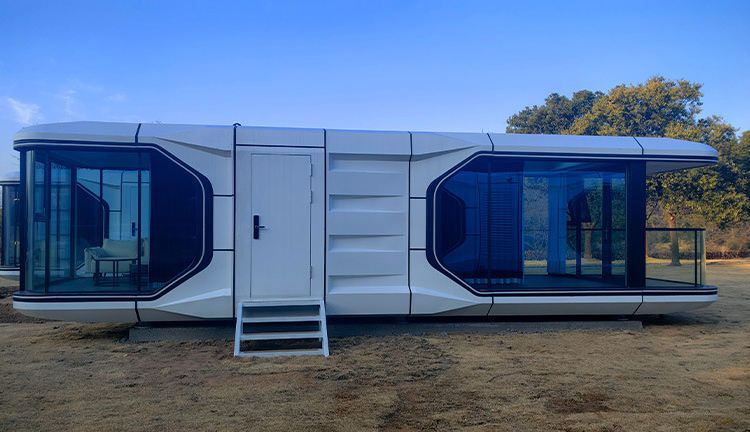
Sea freight is the core method for cross-regional transportation of container houses, especially suitable for international trade scenarios. Its key advantages lie in low transportation costs and large carrying capacity, making it suitable for long-distance and large-scale transportation needs. Sea freight containers have uniform internal size standards, but traditional fixed-structure container houses have low space utilization, carry a small amount per container, and have relatively high overall transportation costs. Therefore, foldable container houses adapted to sea freight have become the mainstream choice. After being folded, these houses fully comply with the loading specifications of standard sea freight containers, eliminating the need for additional customized transportation carriers. Moreover, their overall structure is stable and can withstand the bumps, vibrations, and salt spray corrosion during sea freight. For example, the modular houses customized by China Construction Integration Building Intelligent Manufacturing (Shenzhen) Co., Ltd. for an Australian project were manufactured in the factory and transported by cargo ship for about 20 days to reach Australia. After on-site assembly, they were ready for immediate occupancy. In addition, the value of exported movable houses at Shenzhen ports in the first four months reached 1.68 billion yuan, a year-on-year increase of 19.6%, with destinations covering more than 150 countries and regions, fully demonstrating the dominant position of sea freight in the transportation of container houses.
Rail freight is suitable for inland or cross-border land transportation scenarios, especially widely used in regions such as Central Asia and Europe. For example, exported movable houses from Shandong and Xinjiang can be transported to the markets of the five Central Asian countries and Russia and other Russian-speaking regions via the China-Europe Railway Express. A railway wagon can carry two 20GP or one 40GP containers, with relatively high transportation efficiency. The advantages of rail freight include strong timeliness and relatively little impact from natural conditions, making it suitable for projects with high time requirements. In addition, the rail freight network has extensive coverage and can provide door-to-door services, reducing transfer links and transportation losses. For example, Beijing Hua'an Shunda Freight Forwarding Co., Ltd. provides one-stop services for the relocation and transfer of container temporary building projects, including planning approval, spatial layout design, integrated house disassembly, modification, and transportation, demonstrating the flexibility and professionalism of rail freight in the transportation of container houses.



