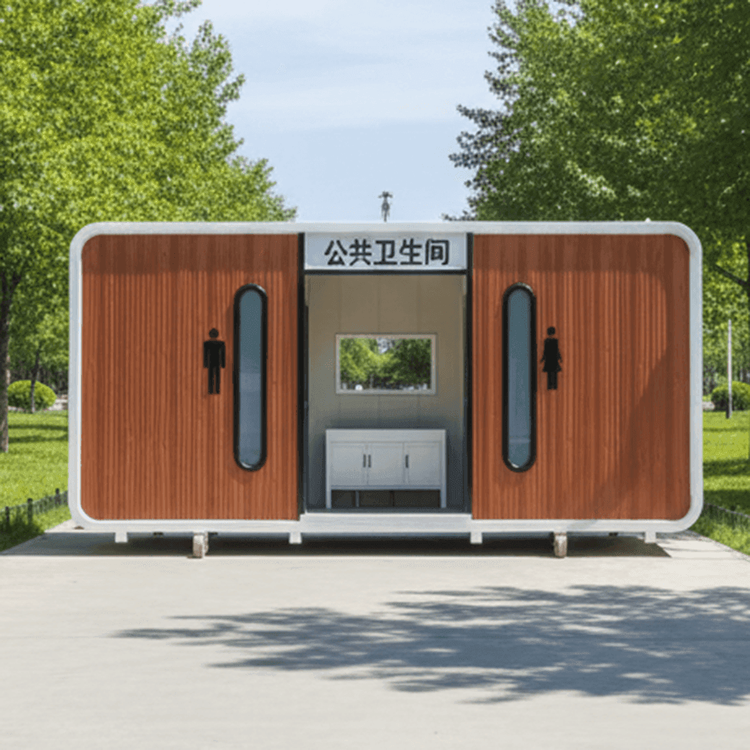
People's Liberation Army Field Mobile Toilets
People's Liberation Army field mobile toilets come in various types, focusing on portability, durability, and sanitation to meet the needs of different combat and training scenarios.

I. Classification by Structure and Usage Scenarios
- Field Toilet Tents: These use a temporarily erected tent structure with internal partitions to divide the space. Squat pits and urinals are formed through temporary excavation. Such toilets are suitable for short-term training camps or temporary encampments, offering flexibility in setup and dismantling. However, they require regular cleaning and burial of waste to reduce environmental pollution.
- Field Ecological Toilets: Composed of multiple independent pits forming a communal toilet area, these use biodegradation or composting techniques to treat waste. Their advantage lies in reducing logistical transportation pressure, as waste can be converted into harmless substances, making them suitable for long-term encampments or ecologically sensitive areas.
- Portable Folding Toilets: Designed for individual soldiers or squads, these feature lightweight plastic or aluminum alloy frames that fold into a compact size for quick assembly. Some models come with sealed bags to collect waste, facilitating easy carrying and cleaning, and are suitable for use during marches or temporary rest stops.
- Medical Rescue Special Toilets: Designed for the wounded, these are equipped with handrails, height adjustment features, and non-slip mats, with medical collection bags connected at the bottom. These devices prioritize safety and convenience and are commonly used in field hospitals or for transporting the wounded.
II. Classification by Function and Scale
- Modular Field Toilet Systems: Comprising multiple independent compartments, each containing a toilet, sink, and disinfection device, these can be quickly assembled based on the number of users. Some systems integrate solar-powered lighting and ventilation equipment, adapting to special environments like plateaus and deserts, and are suitable for division- or brigade-level units.
- Emergency Support Toilets: These include rapidly deployable toilets (inflatable or assembled from prefabricated parts, set up within 30 minutes) and individual emergency bags. The former come with sealed collection boxes for easy removal, while the latter are lightweight and portable, used with simple stands to reduce exposure risks, suitable for emergency tasks like disaster relief and peacekeeping.
III. Principles of Waste Disposal in Field Exercises
During exercises, the principles of dispersion, concealment, pollution prevention, and ease of cleaning are followed. Temporary latrine pits (such as "cat holes" or "field latrines") or folding field toilets connected to waste collection bags are used. For long-term encampments, engineering troops dig large "communal latrines" and apply lime for disinfection, with regular burial or cleaning. During marches, officers and soldiers must relieve themselves away from water sources and in concealed locations. Large-scale exercises may be equipped with "latrine vehicles" to provide temporary facilities. Additionally, the military conducts regular hygiene education, and at the end of exercises, latrine pits are filled in, garbage is cleaned up, and the site is restored to its original condition.