
Production of Online Celebrity Mobile Toilets
The production of online celebrity mobile toilets can be achieved through the modification of water storage tanks or the integration of solar energy systems, requiring design considerations for structure, mobility, and sewage treatment methods.
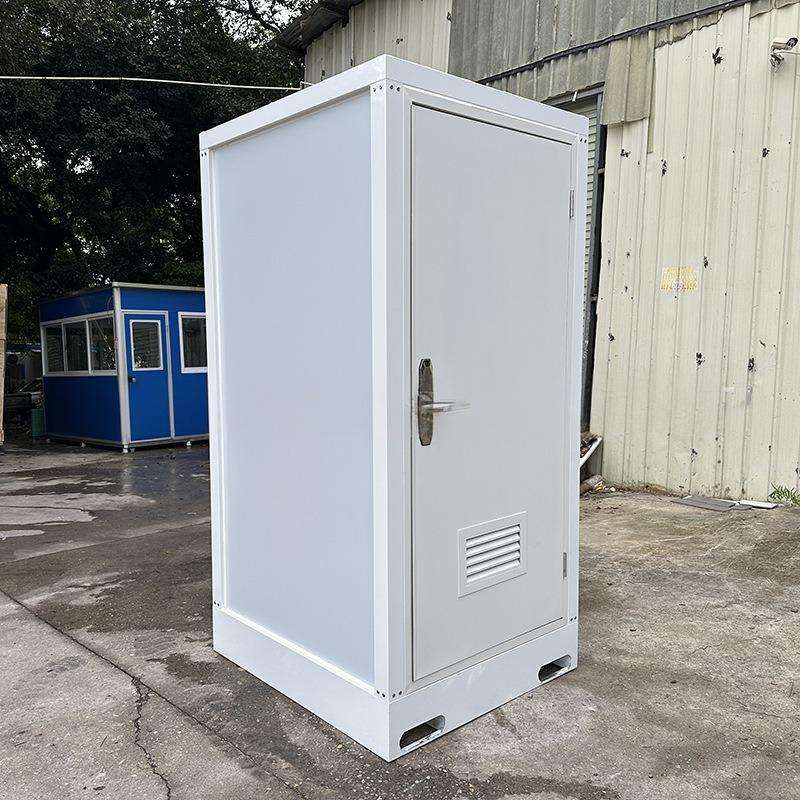
1. Mobile Toilet Modified from a Water Storage Tank
This solution uses a water storage tank as the core material, achieving basic functionality through structural modifications:
Main Structure Construction
Split the water storage tank longitudinally along its central axis, retaining the semi-circular tank body as the main structure of the toilet. Install universal wheels at the four corners of the tank bottom to ensure mobility. Use wooden strips to raise the height along the tank edges, creating a space approximately 2 meters high. Cut rectangular openings on the sides and install door frames, embedding plastic soft panels as walls. Cover the top with the other half of the water storage tank as the roof, forming an enclosed space.Functional System Integration
- Drainage System: Drill holes at the bottom of the tank, connect PVC drainage pipes to form floor drains, and attach external water storage devices (such as plastic water tanks) on the sides to collect sewage, preventing direct discharge from polluting the environment.
- Sanitary Facilities: Install a simple toilet (such as a portable flush toilet) and a small water tank. The sink can be designed as a wall-mounted type to save space.
- Ventilation and Heating: Reserve ventilation openings on the roof and install small exhaust fans. In winter, a bathroom heater can be added to raise the temperature, enhancing user comfort.
2. Solar-Powered Water Storage Tank Mobile Toilet
Upgrade the energy system based on basic modifications to achieve a combination of environmental protection and functionality:
Solar Power Supply Module
Install monocrystalline silicon solar panels (approximately 200W in power) on the roof, connect them to a storage battery (12V 100Ah) to store electrical energy, and supply power to lighting, exhaust fans, and bathroom heaters. The circuit needs to be equipped with an inverter (12V to 220V) to adapt to household appliances.Structural Optimization
- Composite Structure: Adopt a dual water storage tank parallel design, with one serving as the main structure of the toilet and the other as a solar equipment compartment, improving space utilization.
- Power Trailer: Install a trailer device at the bottom, which can be connected to a vehicle for long-distance movement, suitable for scenic spots or event sites.
3. Classification and Design Considerations of Mobile Toilets
- Structural Forms
- Single Structure: Suitable for small-scale scenarios (such as family camping), represented by water storage tank modifications, with low cost but limited functionality.
- Composite Structure: Integrates multiple functional modules (such as solar energy and sewage treatment), suitable for high-traffic public areas.
- Mobility Methods
- Lifting Type: Transported by a crane, suitable for repeated use at fixed locations.
- Power Trailer Type: Equipped with wheels and a trailer device, allowing rapid deployment to different sites.
- Sewage Treatment
- Flush Type: Requires connection to a water source and sewage pipeline, suitable for areas with infrastructure.
- Waterless Suction Type: Uses a vacuum pump to suction feces, storing them in a sealed tank for regular cleaning, suitable for water-scarce environments.
- Recirculating Flush Type: Purifies sewage through biological degradation or chemical treatment to achieve water reuse, offering the best environmental protection.
When designing, it is necessary to comprehensively consider usage scenarios, costs, and environmental protection requirements, prioritizing modular design for easy maintenance and upgrades in the future.



