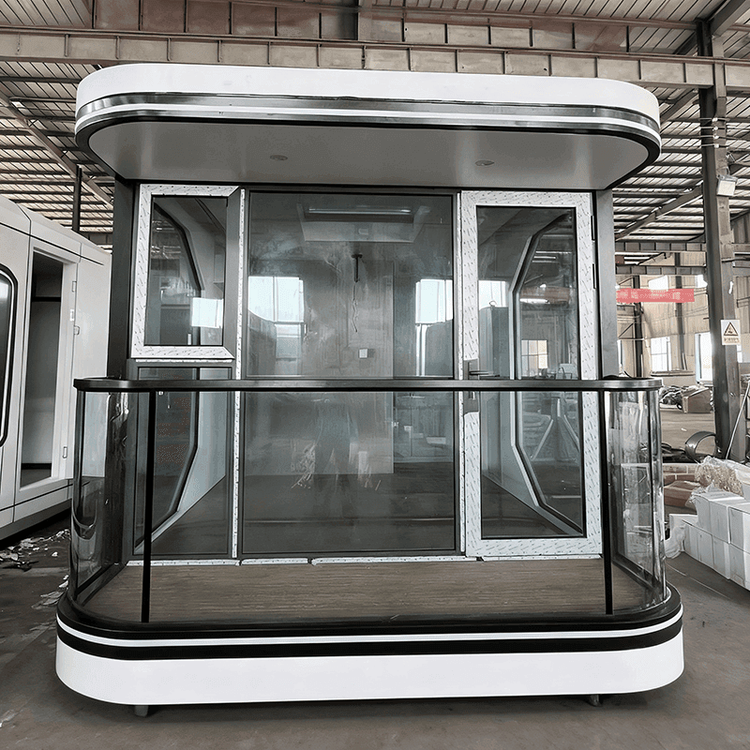
Mobile Toilet Exhaust
The exhaust system for mobile toilets requires comprehensive design from aspects such as site selection, equipment, piping, filtration, and intelligent monitoring to ensure effective ventilation and reduce odors.

Site Selection and Air Inlet Direction Control
When renting mobile toilets, prioritize locations with good natural ventilation conditions. Avoid placing them in low-lying areas or the leeward side of buildings to minimize odor accumulation. Adjust the toilet orientation based on local prevailing winds: in summer, face the air inlet southeast to utilize natural airflow to carry away odors; in winter, adjust to a leeward direction to reduce direct cold air exposure. This design effectively utilizes natural ventilation and reduces reliance on mechanical exhaust.
Ventilation Equipment Power Matching
For a single mobile toilet, it is recommended to install a small exhaust fan with a power of ≥5W to meet basic air exchange needs. For large toilets used by multiple people, a dual-fan parallel design can be adopted to achieve an air exchange rate of 8-10 times per hour. When renting, confirm whether the equipment has rainproof functionality and prioritize exhaust fans with an IP54 or higher protection rating to prevent water ingress and equipment damage.
Piping Layout and Airflow Optimization
Exhaust pipes should be as short and straight as possible to reduce bends and minimize ventilation resistance. When renting multiple toilets side by side, a centralized exhaust main pipe can be used for connection, with each branch pipe equipped with an air volume control valve for individual air volume adjustment. The pipe outlet should be fitted with rainproof louvers to prevent water backflow and affect equipment operation. Additionally, the pipe material should be corrosion-resistant and easy to clean to extend service life.
Odor Filtration System Configuration
Simple exhaust alone is insufficient to completely eliminate odors. Install activated carbon filter pads or photocatalyst filters in front of the exhaust fans to adsorb or decompose odor molecules. When renting, check the filter replacement cycle and prioritize washable filter materials to reduce long-term usage costs. During summer when mosquitoes are prevalent, mosquito nets can also be installed at the air inlets to prevent insects from entering the toilet interior.
Intelligent Monitoring and Emergency Response
For large-scale event scenarios, simple air quality sensors can be installed. When the odor concentration exceeds the standard, the exhaust system automatically activates for intelligent management. At the same time, an emergency plan should be formulated, such as preparing backup power interfaces to ensure continuous equipment operation during extreme weather conditions. The rental party should conduct advance drills for equipment failure handling procedures to avoid unexpected situations at the event site.
In addition, there are brands such as Airmate, Midea, and Panasonic offering bathroom exhaust fans on the market, with differences in price, functionality, and size among different models. For higher performance requirements, consider 304 stainless steel microbial degradation toilets, which feature constant temperature and humidity control and odor-resistant exhaust functions, suitable for scenarios with high environmental requirements.