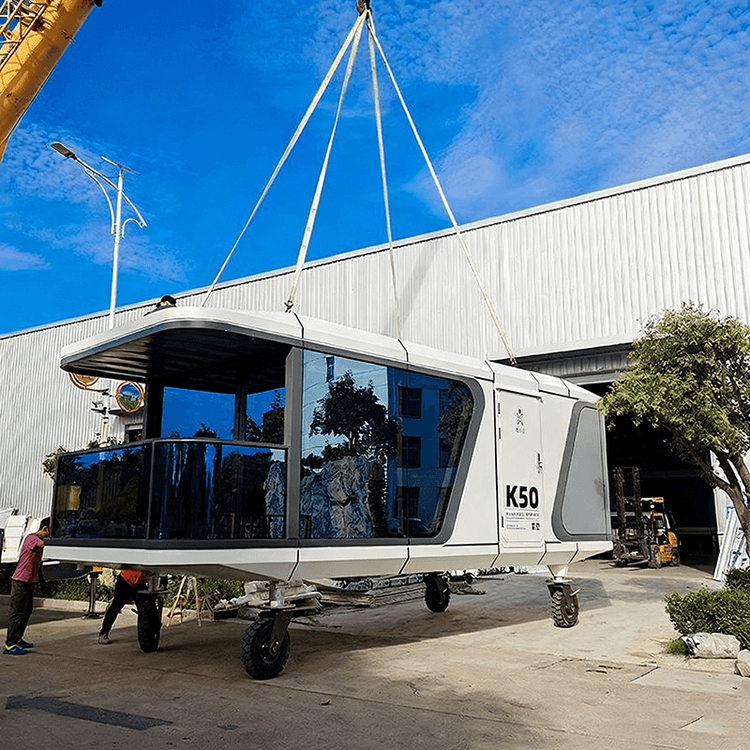
Tianjin Residential Container House
Represented by Falilai Prefabricated Building (Tianjin) Co., Ltd., Tianjin's residential container houses are characterized by easy installation, flexible combination, environmental protection, and durability. They are widely used in temporary construction sites, project offices, temporary dormitories, and other scenarios.

I. Product Types and Characteristics
Residential container houses in Tianjin mainly include packing-box units and foldable containers. Packing-box units are based on a steel frame and lightweight wall panel structural system, consisting of a top frame, bottom frame, corner columns, and interchangeable wall panels. They can be packed for transportation, facilitating both land and sea transport. They offer flexible combinations, can be used as a single unit or combined into open large spaces, and can be stacked up to three floors. They come with complete accessories and can be paired with roofs of different shapes, corridors, canopies, stairs, as well as dedicated bathroom and kitchen units. Foldable containers are also based on a steel structural frame and lightweight wall panel system, consisting of an integrated bathroom unit, a foldable top frame, bottom frame, corner columns, and detachable wall panels. They require minimal on-site construction and are particularly suitable for sites with tight schedules.
II. Application Scenarios
Residential container houses have a wide range of application scenarios in Tianjin. In temporary construction sites, their ease of disassembly, installation, and mobility reduces preparation time and costs before construction. In project office settings, they feature an exquisite appearance and complete equipment, meeting office needs. As temporary dormitories, they provide a comfortable living environment for workers. Additionally, they can be used as security booths, housing in mountainous areas, and temporary accommodation for post-disaster reconstruction.
III. Environmental Advantages
Residential container houses made from new raw materials reduce the use of cement and bricks, thereby lowering environmental damage. The mining and manufacturing of cement and bricks consume large amounts of soil and energy and generate waste gases and residues. The use of residential container houses indirectly reduces the production of these pollutants, and steel can be recycled and reused, facilitating resource circulation. For residential container houses refitted from discarded containers, they make full use of resources and reduce energy consumption and waste gas emissions.