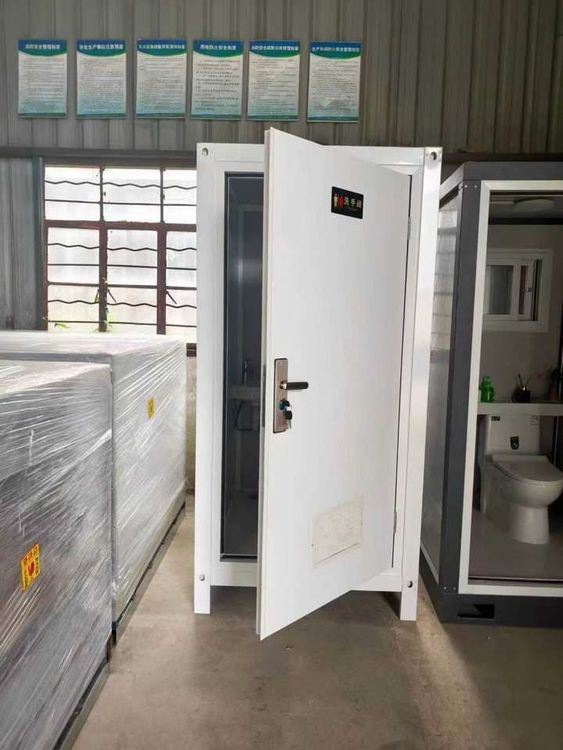
Tianjin Mobile Toilet Installation
The installation of mobile toilets in Tianjin requires a rigorous process, covering transportation preparation, installation construction, material selection, and acceptance standards. The specific key points are as follows:

I. Pre-transportation Preparation
- Demand Confirmation and Site Survey: It is necessary to clarify the model, quantity, and installation location of the mobile toilets, with a focus on evaluating the site's flatness, space adequacy, obstacle distribution, and vehicle accessibility. For example, projects in Tianjin's scenic spots need to reserve space for hoisting operations to avoid obstructions from trees or fences.
- Equipment Inspection and Reinforcement: Check the integrity of the box structure, door locks, flushing devices, and ventilation systems, and secure internal movable components (such as partitions and handrails) to prevent damage caused by transportation vibrations.
- Vehicle and Route Planning: Select flatbed trucks or low-sided trucks based on the toilet size (e.g., single-toilet modules are 2.5-3 meters long), and plan transportation routes that avoid morning rush hours and height-restricted sections to ensure timeliness.
II. Installation Process
- Foundation Construction: Use prefabricated concrete foundations (with a load-bearing capacity of ≥5 kN/m²) or detachable steel frame foundations. The Tianjin Binhai New Area project once used bolted ground beams for easy disassembly and restoration later.
- Modular Assembly: The factory-prefabricated toilet bodies are assembled using cranes, with quick-connect fittings for water and electricity pipelines. The installation time for a single toilet can be reduced to 1.5-2 hours.
- Site Re-survey and Positioning: Clear debris from the site before hoisting and use laser levels to mark positions, ensuring that the toilet spacing complies with barrier-free design specifications (e.g., aisles ≥1.2 meters wide).
III. Design Adaptation and Materials
- Climate Adaptability Design: For the low winter temperatures in Tianjin (below -20°C), the main frame is made of 304 stainless steel or 6063-T5 aluminum alloy, and the ventilation system is equipped with windproof louvers to reduce heat loss.
- Weather-resistant Material Application: The exterior walls use SMC molded panels or metal carved panels (e.g., a customized project in Tianjin used 12mm-thick carved panels with a thermal conductivity of ≤0.03 W/m·K). Sanitary fixtures use ceramic cartridge faucets and odor-proof water seal squat toilets to extend service life.
IV. Acceptance and Maintenance
After installation, the toilets must pass the inspection according to Tianjin's "Technical Requirements for Mobile Environmental Sanitation Facilities" (DB12/T 690-2015), with a focus on checking air tightness (air leakage ≤0.5 m³/h), drainage tightness (no leakage for 24 hours), and floor slip resistance (friction coefficient ≥0.6).
Service Provider Reference: Haoshitong Pipeline Engineering (Beijing) Co., Ltd. provides integrated services for mobile toilet rental, sales, and installation in the Tianjin area, supporting customized designs.