
Three-Dimensional Mobile Toilet Finished Product
There are mainly two types of three-dimensional mobile toilet finished products: one requires no civil engineering for overall finished installation, and the other is homemade using a water storage tank.
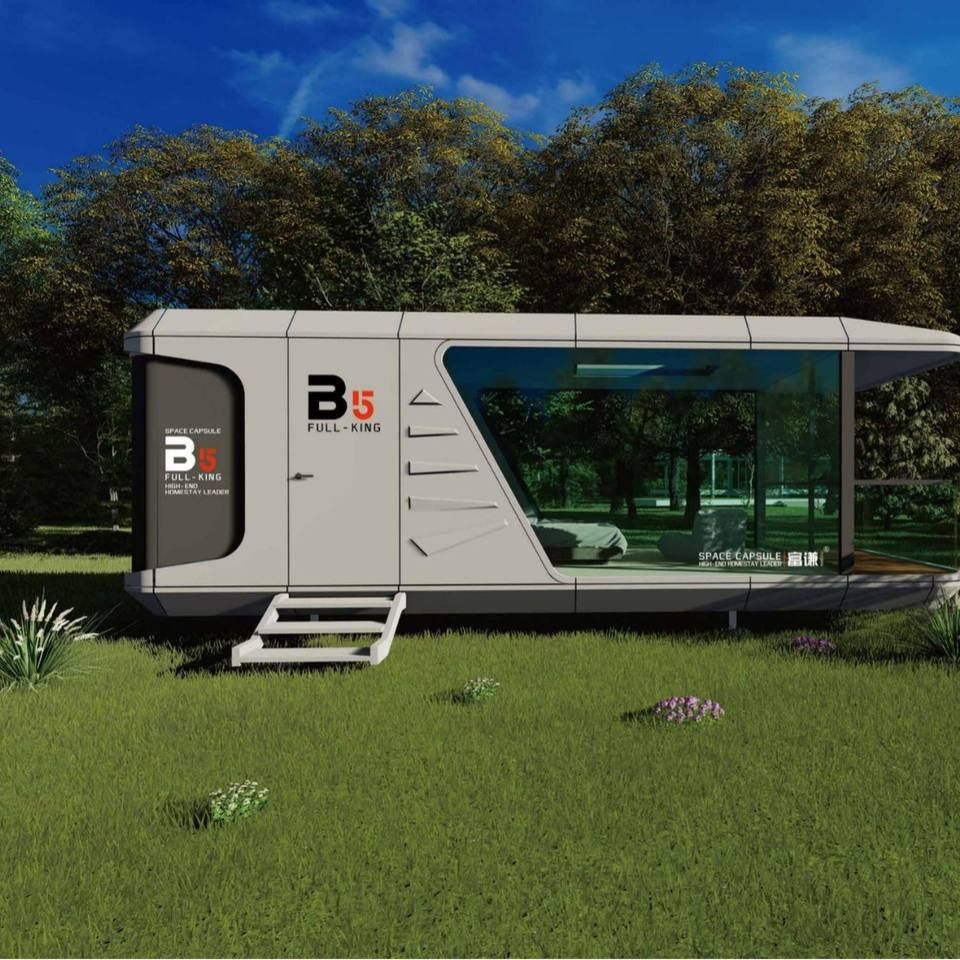
Mobile Toilet with Overall Finished Installation Without Civil Engineering
This type of mobile toilet is characterized by its high convenience. It is an overall finished product, and no complex civil engineering work is required during installation. Specifically, the installation process is like building with building blocks. Initially, there is just a pile of parts on the ground, which can be assembled into a complete toilet through the use of columns and splicing and fixing methods. During construction, there is no need to dig a septic tank like with traditional toilets, nor is there a need for other complex civil engineering operations. Moreover, each buckle is precisely designed to ensure the structural stability and airtightness of the toilet. This type of mobile toilet can be used immediately upon placement, greatly saving construction time and cost. It is especially suitable for temporary venues or scenarios with high requirements for construction speed, such as large-scale outdoor event sites and construction sites. At these locations, facilities that meet people's toilet needs can be quickly set up, providing convenience for the smooth progress of events or the daily work of workers.
Homemade Portable Toilet Finished Product Using a Water Storage Tank
The production process of this type of toilet is relatively complex and creative. First, use an angle grinder to split the water storage tank in half, which is the basic step of production. Next, fix universal wheels at the four corners of a wooden board to facilitate the movement of the entire toilet. Use wooden strips and self-tapping screws to increase the height of the tank to meet usage requirements. Cut an opening on the side of the water storage tank, install sponge strips to form a door frame, embed plastic soft boards to create raised walls, and place the upper half of the water storage tank on top of the wooden strips to form a roof. To protect the wooden strips, apply white waterproof paint to them. Use foam strips to拼接 (here, 'splice' is used as a general translation since '拼接' has no exact single-word English equivalent in this context but means to join pieces together) discarded honeycomb wooden boards to make a simple door. Cut an opening at the bottom of the tank and install a drain pipe to form a floor drain. Cut holes on the side and bottom of a plastic bucket and connect them with direct fittings. Place the plastic bucket on the roof to form a small water storage device and connect a shower made of water pipes. Install a tee fitting below the water inlet pipe and connect a showerhead. Place a toilet and install a water tank, fixing it with glass glue. Connect the drain pipe to a sewage tank. Horizontally connect a water pipe from the tee fitting on the water outlet pipe and extend it to the door as the water inlet pipe for the sink. Cut an opening on the door and install a fitting to connect a hose, etc. Through this series of precise operations, a relatively fully functional portable toilet is completed.



