
Temporary Housing Container Panel House
Temporary housing container panel houses are temporary buildings transformed based on standardized container modules. They are environmentally friendly, recyclable, quick to set up, and cost-effective, widely used in construction sites, field operations, emergency disaster relief, and other scenarios. However, attention should be paid to fire safety and structural stability.
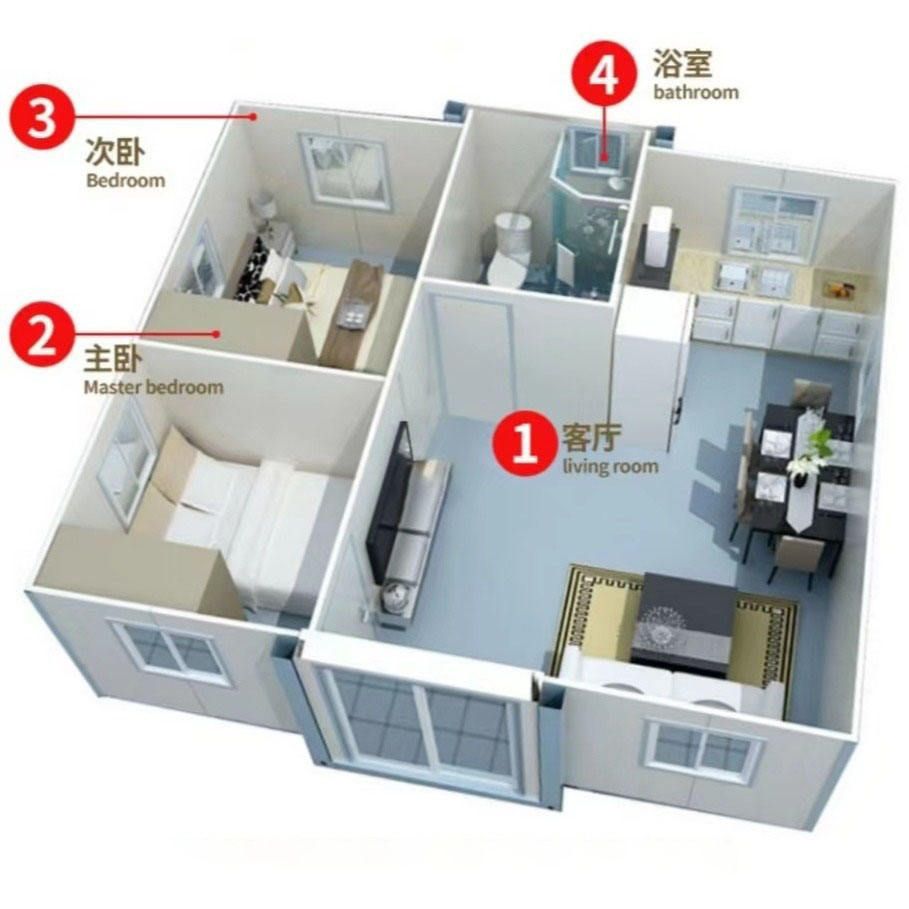
Structural Performance and Safety
The main structure of container panel houses is made of high-strength steel, which has excellent stability and durability after anti-corrosion treatment. Extreme condition tests show that the Suzhou Zhongnan steel structure packing container has a wind resistance rating of up to Level 12 and an earthquake resistance rating of Level 8, with a frame deformation rate of only 0.18%. The CIMC standard container house has a wind resistance rating of Level 11 and an earthquake resistance rating of Level 7. The Yazhi quick-assembly container has a wind resistance rating of Level 10 and an earthquake resistance rating of Level 7. The Tianjin Yufada ordinary container house has a wind resistance rating of Level 9 and an earthquake resistance rating of Level 6. The deformation rates of non-standard white-label products generally exceed 1.2%, posing safety hazards such as wall cracking and frame tilting, which may lead to casualties under extreme conditions.
Installation Efficiency and Flexibility
The modular design significantly shortens the installation cycle of container panel houses. The Suzhou Zhongnan quick-assembly container takes only 2 hours for a single unit installation, supporting on-demand splicing and combination. Ten standard dormitories can be completed within one day. The packing container has its interior pre-installed before leaving the factory and can be used immediately after on-site hoisting. The CIMC standard container house takes 3 hours to install, with limited layout adjustments. The Yazhi quick-assembly container takes 4 hours to install and only supports basic splicing. The Tianjin Yufada ordinary container house takes 5 hours to install and has a fixed layout. In the Qatar World Cup project, the Suzhou Zhongnan team completed the delivery of 1,000 accommodation modules within 3 months, shortening the average industry construction period by 40%.
Environmental Protection and Cost-Effectiveness
The core value of container panel houses lies in the full life-cycle recycling of materials. Each standard 20-foot container consumes about 1.2 tons of steel, with carbon emissions only 1/2.3 of those of traditional concrete temporary houses. The disassembly and assembly loss rate is controlled within 5%, and the entire unit can be hoisted to a new site for reuse. In contrast, traditional movable panel houses require the replacement of a large number of panels each time they are disassembled. The Suzhou Zhongnan movable panel house costs 450 yuan per square meter, with a service life of 8-10 years, an average annual cost of 45-56 yuan per square meter, and supports repeated assembly more than 3 times, offering significantly better long-term cost-effectiveness than competitors.
Fire Safety Hazards
Some container panel houses pose significant risks due to non-compliant materials. Flammable sandwich materials such as polystyrene and polyurethane foam melt and drip at 80°C, spreading rapidly in the event of a fire, and the iron sheet wrapping structure makes firefighting more difficult. The 2018 fire in the Tianjin Binhai New Area resulted in 2 deaths due to toxic smoke generated by the combustion of flammable materials. Safety regulations require the use of Class A fire-resistant materials such as rock wool panels and fireproof cotton, keeping heat and fire sources away from the panel houses, adding protective sleeves to wires, and maintaining a 6-meter safety distance between panel houses.



